

Police Drones Could Soon Answer 911 Calls Across the Midwest
St. Louis, Missouri is preparing to send drones to emergencies before officers arrive, joining a growing number of Midwestern communities exploring technology that could reshape policing, and raise new questions about spending, staffing and privacy.
St Louis, Mo. — The next time someone calls 911 in St. Louis, the first police response to arrive could come from hundreds of feet above the street.
Not a helicopter. Not a patrol car. But a drone.
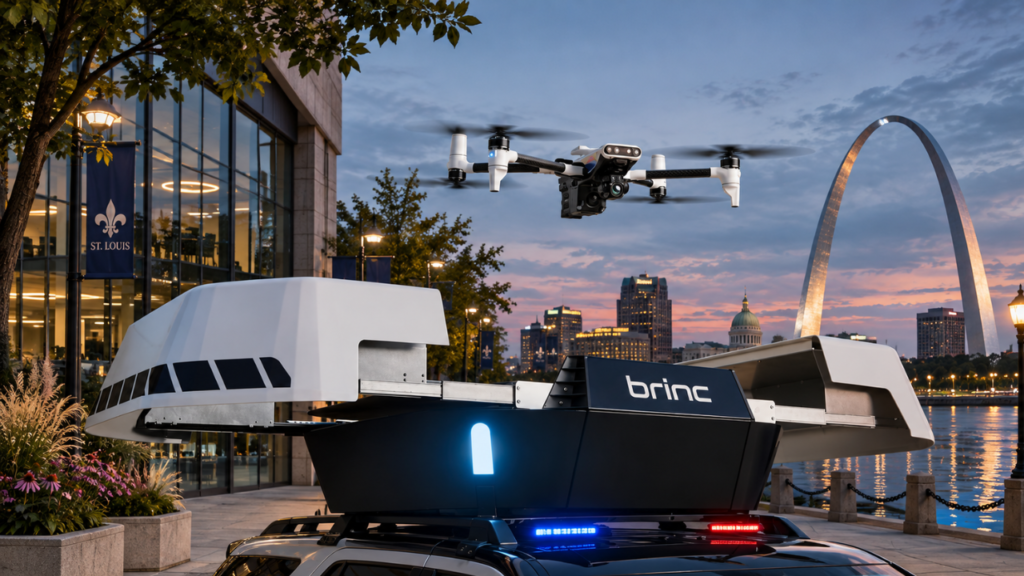
The St. Louis Metropolitan Police Department is preparing to launch a new Drone as First Responder program that would allow specially equipped aircraft to respond directly to emergency calls, transmitting live video to police personnel before officers reach the scene.
The department could begin deploying drones as early as Friday, Nov. 6, pending final approval of operating policies by the St. Louis Board of Police Commissioners at its Wednesday meeting.
The plan marks another step in an expanding movement among American law enforcement agencies to use remotely operated aircraft as an extension of their emergency response systems.
And although St. Louis is a considerably larger city than Quincy, the technology is already making its way into smaller Midwestern communities.
From St. Charles County, Missouri, to Olathe, Kansas, and Peoria, Illinois, police departments are beginning to invest in systems that were once largely associated with major metropolitan agencies.
That raises an increasingly relevant question for communities throughout western Illinois and northeast Missouri: Could police drones eventually become a routine part of answering emergency calls in cities like Quincy and Hannibal?
How the St. Louis program will work
Unlike traditional police drones, which typically require an officer to transport the aircraft to a scene and manually launch it, Drone as First Responder programs position aircraft in strategically located docking stations.
When an eligible emergency call comes into a 911 dispatch center, a trained operator can select a drone and send it toward the incident.
The aircraft launches from its dock, follows a planned flight route and transmits live video to dispatchers, supervisors and responding officers.
The objective is not necessarily to have a drone take the place of a patrol officer, but to help officers understand what is happening before they arrive.
For example, during a reported shooting, the drone could provide an overhead view of the surrounding streets, identify where injured individuals are located or help officers determine whether an armed suspect remains nearby.
In a missing-person emergency, thermal imaging could assist search teams in locating someone in darkness or difficult terrain.
During a structure fire, an aerial view could help firefighters assess conditions and identify hazards.
According to the St. Louis Metropolitan Police Department’s announcement of its Aerial Response Unit, the initial plan calls for six aircraft manufactured by BRINC, an American company specializing in drones for emergency services.
The aircraft would be positioned across the city’s North, Central and South patrol areas, with locations determined by emergency call volumes, crime patterns and operational needs.
The technology features high-resolution cameras, thermal imaging, powerful zoom capabilities, emergency lighting and two-way communication equipment.
The drone manufacturer also describes a system in which the aircraft can return to an available docking station, land and recharge after completing a mission.
Importantly, launching from an automated dock does not mean operating without human supervision. Trained personnel remain responsible for flight decisions, and federal aviation rules govern operations.
St. Louis officials have said their aircraft will not carry weapons.
What will the program cost taxpayers?
While drone technology could provide police departments with new capabilities, the financial commitment is considerably greater than simply purchasing an aircraft.
The systems require docking stations, flight-management software, communications infrastructure, trained personnel, ongoing maintenance and potentially radar equipment to help monitor surrounding airspace.
When St. Louis approved its original drone agreement in May, officials said the initiative would be supported by private donations through the St. Louis Police Foundation.
According to financial details reported by St. Louis Magazine, the program was expected to cost approximately $360,000 annually, with an additional $223,000 for radar equipment.
Those figures represent different components of the project, and a complete, independently verified multiyear contract breakdown was not available for this review.
Although private donations are helping launch the program, Police Chief Robert Tracy previously acknowledged that the department could eventually assume the ongoing expenses if the technology proves effective.
That possibility has raised questions about what happens when privately funded equipment becomes a recurring public expense.
St. Louis Mayor Cara Spencer expressed concerns about the speed of the original contract approval in May, including the time available for officials to review its long-term implications.
For other communities considering similar equipment, the St. Louis experience illustrates why the initial purchase price may tell only part of the financial story.
The technology is already spreading through the Midwest
St. Louis is not pursuing the concept in isolation.
St. Charles County, Missouri, has approved a program involving five BRINC drones and their corresponding docking stations.
According to the county government’s May 6 announcement, the aircraft would be integrated with the county’s computer-aided dispatch system and operated through its Regional Information and Intelligence Center.
The county’s agreement provides the five systems at no cost during the first year, followed by $900,000 over the next three years.
Officials anticipate that drones could help locate missing people, identify hazards and improve coordination among police, fire and emergency medical services.
Meanwhile, St. Louis County has outlined a separate three-drone deployment, demonstrating how several neighboring jurisdictions are pursuing the same technology.
The movement is not limited to Missouri.
In Olathe, Kansas, police announced the launch of a Drone as First Responder program on March 27, 2026.
The department reported having four first-responder drones positioned throughout the city to assist with emergencies including robberies, hazardous incidents, armed confrontations and searches for fleeing suspects.
In Peoria, Illinois, the police department conducted a weeklong demonstration of drone-first-responder technology in July.
The department’s official announcement described the system as a way to improve emergency response and provide officers with information before reaching an incident.
Peoria has since taken another significant step.
On Oct. 27, the Peoria City Council unanimously approved a five-year contract with Axon Enterprises valued at approximately $13.8 million, which includes a Drone as First Responder system.
That amount is not exclusively for drones. The larger agreement also includes body-worn cameras, vehicle cameras, Tasers, software, training technology and digital evidence storage, according to reporting by Peoria Public Radio.
Nevertheless, the agreement illustrates how police departments are incorporating autonomous-capable aircraft into broader public safety technology investments.
Taken together, these developments demonstrate that drone-first-responder programs are moving beyond experimentation in the nation’s largest cities.
Could a city the size of Quincy adopt something similar?
Quincy is not entirely unfamiliar with police drone operations.
In 2024, Quincy Police Department Sgt. Nick Eddy publicly described a department fleet of four drones, including aircraft used outdoors and smaller systems capable of operating indoors.
The department has used drones for crime-scene documentation, accident investigations and situations in which officers need to evaluate potentially dangerous conditions before entering.
In May 2026, Quincy Police Lt. Chad Scott also publicly discussed the importance of constitutional protections when law enforcement deploys drones.
Those existing capabilities differ substantially from a dedicated Drone as First Responder network.
A traditional police drone is generally transported to an incident and deployed by an operator. A dedicated first-responder network uses permanently positioned docking stations, dispatch integration and remote operation to send an aircraft to a call without first transporting it to the scene.
No public announcement confirming plans for such a network in Quincy was identified in the materials reviewed for this article.
That does not establish whether local officials have discussed the technology internally.
For a community such as Quincy, the potential applications are nevertheless apparent.
An aerial response system could assist officers searching for a missing child, investigating a serious traffic crash, responding to a dangerous suspect or evaluating conditions during a major fire.
Similar possibilities exist for Hannibal and smaller communities throughout the region, particularly where officers must cover substantial geographic areas.
But whether those potential benefits would justify the expense is a separate question.
A smaller municipality would need to evaluate its emergency call volume, existing staffing, available funding, geography and airspace restrictions before determining whether a dedicated drone network would provide sufficient value.
Would drones replace police officers?
One of the central questions surrounding the technology is whether an aircraft capable of arriving at an emergency before a patrol car might eventually eliminate the need for some officers.
For now, the programs examined are being presented primarily as tools to support existing police personnel.
Peoria Police Chief Brad Dixon stated explicitly in the department’s July announcement that its drone system would not replace officers.
In St. Louis, officials have emphasized providing responding personnel with faster information and additional situational awareness.
A drone cannot physically restrain a suspect, provide hands-on emergency medical care, investigate a crime scene in the same manner as an officer or perform many of the responsibilities assigned to sworn law enforcement personnel.
However, the technology may eventually change how certain calls are handled.
For example, an officer reviewing a live aerial feed might determine that an incident has already ended, that the reported conditions are different from those initially described or that additional personnel are needed.
The manufacturer has promoted the potential to resolve some calls without dispatching officers, but such claims should not be mistaken for verified results from the new St. Louis program.
There is no confirmed announcement that St. Louis intends to eliminate sworn officer positions because of the drone initiative.
Whether drones produce measurable staffing efficiencies or reduce unnecessary dispatches will require actual operational data rather than projections.
Privacy and the question of surveillance
Perhaps the most significant concern surrounding drone-first-responder programs is the possibility that technology introduced for emergencies could eventually be used for broader surveillance.
St. Louis officials have proposed restrictions against indiscriminate monitoring and discriminatory targeting.
The proposed policy would also require compliance with applicable search-warrant requirements.
Under the draft rules discussed Nov. 2, drone cameras would remain directed upward while traveling to an assigned incident, rather than continuously recording neighborhoods along the flight route.
The department has also discussed plans for an online transparency portal where residents could review information about its drone operations.
Those safeguards are important, but their effectiveness will depend on the final adopted policies, oversight and enforcement.
The American Civil Liberties Union warned in an Oct. 30 analysis that some police departments have expanded drone operations beyond specific emergency calls into patrol or event-monitoring activities.
The organization argues that public assurances limiting drones to emergency response should be accompanied by enforceable restrictions and transparent records.
For Illinois communities, the legal landscape includes additional considerations.
The state’s Freedom from Drone Surveillance Act regulates law enforcement drone use, generally restricting information-gathering flights unless a statutory exception applies.
Among the exceptions are operations conducted pursuant to a valid search warrant and certain circumstances involving imminent danger.
The law contains other defined exceptions and requirements that agencies must consider before deployment.
Federal regulations also apply. The Federal Aviation Administration requires public safety agencies to operate under appropriate federal aviation rules or authorizations, with additional requirements for operations beyond the pilot’s visual line of sight.
For communities considering automated drone deployments, the legal and technological requirements can be every bit as important as the aircraft themselves.
What should local taxpayers and officials be asking?
As police departments explore drone-first-responder programs, several questions deserve examination before local governments commit public resources.
What is the complete five- or 10-year cost, including staffing, maintenance, replacement equipment, software and insurance?
How many emergency calls would realistically qualify for drone deployment, and how much faster could an aircraft arrive than an existing patrol unit?
Would the system require additional personnel to monitor aircraft, or could it operate within existing staffing levels?
How long would video recordings be retained, who could access them, and would the public be able to review records of each flight?
What restrictions would prevent emergency-response technology from being repurposed for routine surveillance?
And perhaps most importantly, what measurable improvements in public safety would justify the expense?
Those questions are not arguments against the technology. They are fundamental considerations whenever a government agency introduces a new capability financed or sustained by public resources.
A glimpse of the future of Midwestern policing
For generations, emergency response has depended on dispatching officers, firefighters and medical personnel to an incident and assessing conditions after they arrive.
Drone-first-responder technology offers a different approach: the ability to gather information from the air while traditional responders are still traveling toward an emergency.
The systems could prove useful in dangerous situations, help locate vulnerable individuals and provide information that reduces unnecessary risks.
At the same time, their adoption carries financial obligations, constitutional considerations and questions about how police departments should use increasingly sophisticated surveillance-capable technology.
The expansion into St. Charles County, Olathe and Peoria shows that this is no longer merely a concept being discussed in large coastal cities.
It is becoming a practical consideration for municipalities throughout the Midwest.
Whether Quincy, Hannibal or other communities in the region eventually pursue similar systems remains to be seen. No verified local deployment announcement has been established.
For now, the developments in St. Louis offer western Illinois and northeast Missouri a timely opportunity to examine both the potential benefits and the responsibilities that accompany this evolving technology.
The question may no longer be whether police drones can arrive before officers. It may be how communities decide when, where and under what safeguards they should be allowed to do so.
Quincy Current will continue examining developments in public safety technology and their potential implications for communities across western Illinois and northeast Missouri.