

Adams County Voters To Decide 1% School Sales Tax Question on Nov. 3
Quincy Current has heard from residents seeking a clearer explanation of the proposal after receiving communications from Quincy Public Schools encouraging participation in the upcoming election.
QUINCY, Ill. Adams County voters will be asked this November to decide whether to impose a new 1% countywide sales tax that would generate revenue for school facilities, school resource officers and mental health professionals.
The question will appear on the Nov. 3, 2026 General Election ballot and will be presented to voters throughout Adams County. The Adams County Clerk confirms polls will be open from 6 a.m. to 7 p.m. on Election Day, with early voting beginning Sept. 24.
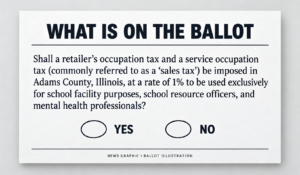
The ballot question reads:
“Shall a retailer’s occupation tax and a service occupation tax (commonly referred to as a ‘sales tax’) be imposed in Adams County, Illinois, at a rate of 1% to be used exclusively for school facility purposes, school resource officers, and mental health professionals?”
A majority of voters casting ballots on the question would have to vote “Yes” for the tax to take effect. Illinois law allows this type of county school tax only with voter approval and permits rates of up to 1%.
The proposal has drawn increasing attention as Election Day approaches.
Quincy Current has received emails from several area residents who said they wanted to better understand what the measure would do before casting their ballots. Some said they had also received communications from Quincy Public Schools encouraging residents to participate in the election and wanted additional information about what exactly voters are being asked to approve.
The district has created a Quincy Together website outlining its case for the proposal and providing information about the tax, school finances and voting. Quincy Together information from QPS
What would the 1% tax mean?
The proposal is commonly described as a one-cent school facilities sales tax.
If approved, an additional one cent would be collected for every dollar spent on purchases subject to the tax in Adams County.
For example, a $100 qualifying purchase would carry an additional $1 in tax.
The tax would be collected countywide rather than solely within Quincy. Revenue would then be distributed among eligible school districts in Adams County based on student enrollment.
That distinction is important because the measure is not exclusively a Quincy Public Schools referendum.
Although QPS represents the largest school district in the county and is prominently promoting the proposal through its Quincy Together initiative, revenue would be shared among Adams County school districts according to enrollment.
What purchases would be taxed?
The additional 1% would not apply uniformly to everything consumers purchase.
The Illinois Department of Revenue says the County School Facility Occupation Tax does not apply to certain categories, including property that must be titled or registered with the state, such as vehicles, as well as qualifying drugs and medical appliances. The law also excludes property otherwise taxed at certain reduced state rates.
Quincy Public Schools specifically tells voters that the additional tax would not be added to unprepared groceries, medicine, vehicles and other exempt purchases.
The tax would instead apply to many ordinary taxable retail purchases made within Adams County.
This also means visitors who shop in Quincy or elsewhere in Adams County would contribute to the revenue even if they do not live here.
QPS says a planning study conducted by PGAV estimates that approximately 60% of the revenue generated for the district would come from shoppers who live outside Adams County. That figure is a district estimate rather than a guaranteed outcome and would ultimately depend on actual taxable sales activity.
How much money could Quincy Public Schools receive?
QPS estimates its share of the tax would generate approximately $8.53 million annually.
The district says it serves more than 6,100 students and maintains more than 1.2 million square feet of school facilities. It has presented the sales-tax proposal as the first portion of a broader two-step financial plan addressing facilities, staffing and long-term finances.
The $8.53 million figure is an estimate based on projected sales-tax collections and enrollment distribution. Actual annual proceeds could rise or fall depending upon retail activity and other factors.
What can the money be spent on?
The ballot itself places legal restrictions on the use of the proceeds.
Revenue would be limited to school facility purposes, school resource officers and mental health professionals.
Under Illinois law, “school facility purposes” can include construction, reconstruction, renovation and improvement of school buildings, acquisition and improvement of property, architectural planning, durable equipment, safety improvements, energy conservation, accessibility, school security and certain repairs. Revenue may also be used in connection with qualifying school-facility debt.
That means the money would not simply become unrestricted general revenue that school districts could spend for any purpose.
QPS has also stated that revenue from the tax cannot be used directly for ordinary salaries and benefits outside the purposes authorized by state law.
The ballot language specifically adds school resource officers and mental health professionals as authorized uses.
Why is QPS asking voters now?
Quincy Public Schools has spent much of 2026 conducting its Quincy Together community-engagement process, including five workshops and a district survey.
According to QPS, 1,607 district residents completed that survey. The district says feedback identified three recurring priorities: supporting students and staff, maintaining school buildings and preserving long-term financial stability.
QPS also reports that more than 50 district positions went unfilled during the previous school year and says its buildings require continued investment in systems including roofs, windows, plumbing, electrical infrastructure, heating and cooling.
Those statements represent the district’s explanation for why it believes additional revenue is needed.
Voters will ultimately decide whether a new countywide sales tax is the appropriate way to address those needs.
What does a Yes or No vote mean?
A Yes vote supports imposing the new 1% tax on qualifying purchases throughout Adams County, with the resulting revenue distributed among county school districts for the purposes specified on the ballot.
A No vote rejects the proposed tax and leaves the current county school sales-tax structure unchanged.
Illinois law requires a majority of those voting on the question to approve the measure before it can be imposed.
A question voters are beginning to examine closely
The measure is likely to receive considerable attention during the remaining weeks before Election Day because it asks voters to balance two significant considerations.
On one side is the potential for millions of dollars in new school funding, including revenue collected from visitors shopping in Adams County.
On the other is the permanent addition of another percentage point of taxation to many purchases made within the county.
Those are policy questions for voters to decide.
For Quincy Current, the goal ahead of Nov. 3 will be to examine the proposal in greater detail, including where the money would go, what purchases would and would not be taxed, how revenue estimates were calculated and what arguments supporters and opponents make before residents cast their ballots.
The Nov. 3 General Election will run from 6 a.m. to 7 p.m., and Adams County voters can begin voting early on Sept. 24.
Additional information from Quincy Public Schools is available through its Quincy Together initiative, while election information is available through the Adams County Clerk.