


Illinois Assisted-Suicide Law Takes Effect as Springfield Diocese Condemns It as “PURE EVIL”
Illinois has become the first Midwestern state to implement a law allowing certain terminally ill adults to obtain medication intended to end their lives, prompting renewed opposition from Catholic leaders, disability advocates and some medical professionals.
SPRINGFIELD, Ill. A deeply controversial Illinois law allowing qualifying terminally ill adults to obtain prescription medication to end their lives is now in effect, opening a new chapter in a years-long debate over personal autonomy, medical ethics, religious freedom and the meaning of compassionate end-of-life care.
The End-of-Life Options for Terminally Ill Patients Act, also known as Deb’s Law, took effect Sept. 12 after Gov. JB Pritzker signed the legislation on Dec. 12, 2025. Illinois is the first Midwestern state to implement such a law, but it is not the first state nationally. When Pritzker signed the legislation, his administration described Illinois as the 12th state to enact a medical-aid-in-dying law.
Supporters refer to the practice as medical aid in dying, while many opponents, including the Catholic Church and the American Medical Association’s ethics code, use the term physician-assisted suicide. That disagreement over terminology reflects the much larger moral and medical divide surrounding the law.
Few Illinois organizations have responded more forcefully than the Diocese of Springfield in Illinois.
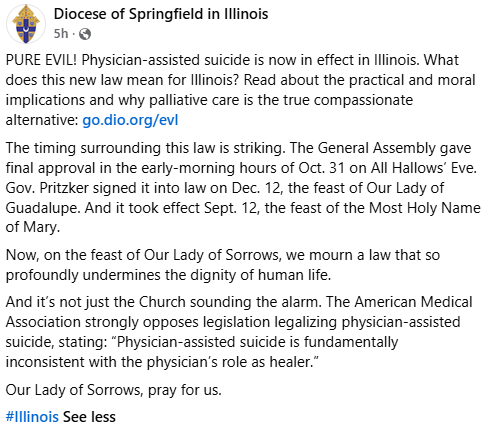
In a statement issued after the law took effect, the diocese opened with two words in capital letters:
“PURE EVIL!”
The diocese went on to urge Illinois residents to consider what it described as both the practical and moral consequences of physician-assisted suicide while promoting palliative care as the compassionate alternative.
Diocese Points to Striking Dates in Catholic Calendar
The Springfield Diocese also called attention to the dates associated with the legislation’s passage, signing and implementation.
The Illinois General Assembly gave final approval to the measure during its Oct. 31 legislative session. Gov. Pritzker signed it Dec. 12, and the law became effective Sept. 12. Official state records confirm the Dec. 12 signing date and Sept. 12, 2026 effective date.
The diocese viewed those dates through a distinctly Catholic lens.
Oct. 31 is All Hallows’ Eve. Dec. 12 is the Feast of Our Lady of Guadalupe. Sept. 12 is the Feast of the Most Holy Name of Mary.
Then, on Sept. 15, the Feast of Our Lady of Sorrows, the diocese renewed its opposition.
“The timing surrounding this law is striking,” the diocese wrote, before recounting the three dates and adding that Catholics now “mourn a law that so profoundly undermines the dignity of human life.”
The diocese concluded its message with a prayer: “Our Lady of Sorrows, pray for us.” Its social media statement characterized the new law as fundamentally incompatible with the Church’s teaching on the sanctity of human life.
Bishop Paprocki Opposed the Measure Before It Became Law
The Springfield Diocese’s objections did not begin this week.
Bishop Thomas John Paprocki strongly condemned the legislation after the Illinois Senate approved it in the early hours of Oct. 31, 2025.
Paprocki argued that allowing physicians to prescribe life-ending medication undermines the physician’s traditional role and creates particular concerns for vulnerable patients, including people with disabilities, the poor and those who may feel pressure because of their medical circumstances.
“Doctors take an oath to do no harm. Now, they can prescribe death,” Paprocki said following the Senate vote.
He also argued that Illinois should respond to suffering with care, compassion and hope rather than intentionally hastening death.
Those concerns continue to form the heart of the diocese’s opposition now that the law has taken effect.
What the Illinois Law Actually Allows
The law applies only to a specific group of patients.
To qualify, a person must be an adult Illinois resident, have the mental capacity to make medical decisions and have an incurable and irreversible terminal disease that, within reasonable medical judgment, is expected to result in death within six months.
The terminal diagnosis must be confirmed following an in-person examination by one physician and concurrence from another physician. The law specifically says a person cannot qualify solely because of advanced age, disability, depression or another mental health condition.
The patient must personally initiate the process. A guardian, family member, health care proxy or person holding power of attorney cannot make the request on the patient’s behalf.
The law generally requires an initial oral request, a written request and a second oral request made at least five days after the first. The written request must be witnessed by at least two people who attest that the patient appears mentally capable, is acting voluntarily and is not being coerced or unduly influenced.
A consulting physician must also confirm that the patient has a terminal illness, possesses decision-making capacity and is acting voluntarily and without coercion or undue influence.
The medication must ultimately be self-administered by the patient. The statute defines that as a conscious and voluntary action by the qualified patient and excludes administration by injection or infusion.
Patients can also change their minds. The law requires physicians to offer another opportunity to rescind the request before the process proceeds.
Supporters Call It an Issue of Autonomy
Pritzker and supporters of the law describe it very differently from the Springfield Diocese.
When signing the measure, Pritzker’s administration said the legislation would allow terminally ill patients facing the final months of life to make deeply personal decisions about their own medical care and potentially avoid unnecessary suffering.
The law itself states that the General Assembly views medical aid in dying as another end-of-life option alongside hospice, comfort care, pain control and palliative care. Legislators supporting the measure argued that mentally capable adults facing terminal diagnoses should be able to make decisions consistent with their personal values and beliefs.
The statute also requires physicians to explain other appropriate end-of-life options, including hospice care, palliative care, comfort care and pain control, before a patient makes an informed decision.
Supporters therefore reject the characterization that the law abandons palliative care. They argue instead that it gives terminal patients another choice alongside those services.
For the Catholic Church, however, making intentionally life-ending medication one of those choices crosses a moral boundary.
American Medical Association Also Opposes Physician-Assisted Suicide
The Springfield Diocese noted that opposition does not come exclusively from religious organizations.
The American Medical Association’s Code of Medical Ethics continues to oppose physician-assisted suicide.
The AMA states that the practice is “fundamentally incompatible with the physician’s role as healer” and says physicians should instead respond aggressively to suffering through emotional support, comfort care and adequate pain control.
The AMA also acknowledges the complexity of the debate. Its ethical guidance recognizes that thoughtful people can reach sharply different moral conclusions and notes that individual physicians who conscientiously participate where the practice is legal are not automatically considered to have violated the AMA Code.
The organization’s formal ethical position, however, remains opposition rather than neutrality.
Death Certificates Become Another Point of Controversy
One provision of Illinois law has also drawn particular scrutiny from opponents.
When a patient dies after self-administering medication under the Act, the statute says the death is attributed to the person’s underlying terminal illness.
It further states that the death is not to be designated as a suicide or homicide and that use of the aid-in-dying medication is not identified on the death certificate.
That provision has already prompted proposed legislation seeking to change how such deaths are recorded, although those efforts have not become law.
For supporters, the provision reflects their position that the terminal illness remains the underlying cause of death.
Opponents argue that it obscures the role played by the prescribed medication.
Religious Freedom Fight Has Already Reached Federal Court
The controversy has also moved from the Statehouse into federal court.
Cardinal Blase Cupich, the Archdiocese of Chicago, the Carmelite Sisters for the Aged and Infirm, the Little Sisters of the Poor and an Illinois pharmacist challenged portions of the new law, arguing that requirements affecting health care providers with religious objections violate constitutional protections for free speech and religious exercise.
Among the disputed provisions is a requirement that a health care professional or institution unwilling to provide aid in dying refer a requesting patient to a willing provider or another party who can assist the patient.
On Sept. 11, a federal judge approved a temporary order preventing Illinois from enforcing certain requirements against the Catholic plaintiffs while litigation continues. The protection is limited to those plaintiffs and does not prevent the law from operating generally across Illinois.
The Christian Post reported Tuesday that Illinois agreed to comply with the order while the constitutional challenge moves forward.
The case therefore does not amount to a court striking down Deb’s Law. It temporarily protects particular religious plaintiffs from provisions they contend would require them to facilitate conduct contrary to their faith.
Two Very Different Understandings of Compassion
At the center of the debate are two fundamentally different answers to the same difficult question.
What does compassion require when someone is facing an incurable illness and approaching death?
Supporters of Deb’s Law say compassion includes allowing a mentally competent terminally ill adult to control the circumstances of his or her final days and avoid suffering that the patient finds intolerable.
The Catholic Church argues that intentionally causing death can never become an act of medical care, regardless of the circumstances, and that true compassion means accompanying a dying person with hospice services, pain management, palliative medicine, family support and spiritual care until natural death.
The Springfield Diocese has made clear where it stands.
Its latest message does not attempt to soften that position.
“PURE EVIL!” was the phrase the diocese chose as Illinois’ new law took effect.
Behind the provocative language is a much older Catholic conviction that human dignity does not diminish with illness, disability, dependency or approaching death, and that suffering should call forth greater care rather than an intentional act to end life.
Illinois law now recognizes a different conclusion.