

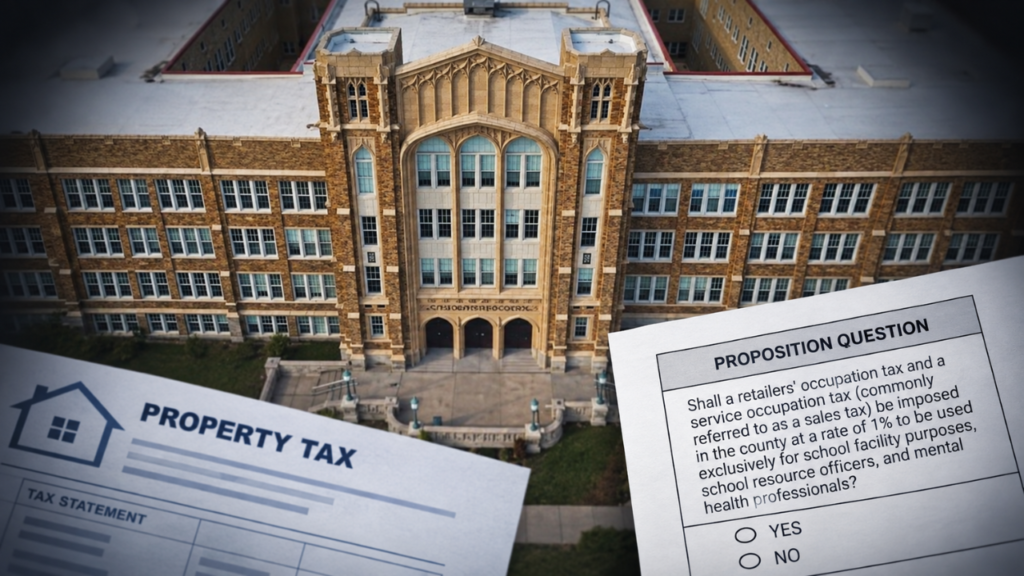
Could a Property-Tax Safeguard Accompany Adams County’s Proposed School Sales Tax?
Could a Property-Tax Safeguard Accompany Adams County’s Proposed School Sales Tax?
As local school districts increase public outreach ahead of the Nov. 3 referendum, one question deserves closer examination: If voters approve a new 1% sales tax, what assurance exists that property-tax collections will not increase as well?
QUINCY, Ill. With early voting approaching, Adams County residents are beginning to hear considerably more about the County School Facility and Resources Occupation Tax that will appear on the Nov. 3 ballot.
Quincy Public Schools has already conducted a five-part Quincy Together community-engagement process and is continuing to provide information about the proposal. The district estimates the 1% countywide tax would generate approximately $8.53 million annually for QPS, with proceeds shared among Adams County school districts according to enrollment. QPS describes the referendum as the first part of a broader financial plan intended to address facilities, student services and long-term finances “without changing the district’s overall property tax rate.” (QPS)
As additional presentations and public discussions take place, however, there is an important distinction voters may want to understand.
A promise not to increase a property-tax rate is not necessarily the same thing as freezing the property-tax levy, which is the total amount of property-tax revenue a taxing district requests.
That distinction raises a broader policy question for Quincy Public Schools and other participating districts: Could the new sales-tax revenue be accompanied by a formal commitment concerning property taxes?
Sales Tax Does Not Automatically Reduce Property Taxes
Illinois law specifies how revenue from the County School Facility and Resources Occupation Tax may be used. Depending upon the ballot language, revenue can support qualifying school facilities, school resource officers and mental health professionals. The law also permits school-facility revenue to be used for qualifying debt obligations. (Illinois General Assembly)
What the statute does not do is automatically require a school district receiving the new sales-tax revenue to reduce its property-tax levy by a corresponding amount.
That means approval of the sales tax does not, standing alone, guarantee lower property taxes or prevent a school district from seeking additional property-tax revenue in future years.
The Illinois Department of Revenue explains that a property-tax levy represents the amount requested by a taxing district, while the tax rate is calculated in relation to the district’s equalized assessed valuation. If the tax base grows, a district can potentially collect more property-tax revenue while maintaining or even reducing its tax rate. (Illinois Department of Revenue)
That difference is particularly relevant because QPS has emphasized maintaining its overall property-tax rate, rather than expressly promising that the total property-tax levy will remain unchanged. (QPS)
For taxpayers, the two concepts should not be treated as interchangeable.
What Happened Elsewhere in Illinois?
One argument frequently presented in favor of school-facility sales taxes is that they can reduce reliance on property taxes by shifting some school costs to retail activity.
There are Illinois districts where that has occurred.
Germantown Hills School District 69, for example, reported that it has used the majority of its County School Facilities Sales Tax revenue to abate its bond-and-interest property-tax levy. The district reported in 2025 that its total property-tax extension was slightly lower than the previous year and said property taxes collected by the district had remained relatively flat despite substantial growth in property values. (Germantown Hills School District 69)
More recently, Eldorado Community Unit School District 4 voted in March 2026 to abate $100,000 after school-facility sales-tax revenues exceeded projections and planned construction projects came in within budget. (Eldorado School District)
And in Lake County, Fremont School District 79 has publicly presented property-tax abatement as one potential use of sales-tax proceeds if voters approve its countywide referendum this November. (Fremont School District 79)
Those examples show that school-facility sales-tax revenue can be used in ways that reduce pressure on property taxpayers.
They also demonstrate that doing so generally requires a policy decision by the local school board.
But Other Districts Increased Property-Tax Levies
There is another side to the experience.
A 2014 investigation by the Illinois Policy Institute, a public-policy advocacy organization, examined Champaign County after voters approved a 1% County School Facilities Sales Tax in 2009.
The organization reported that although supporters had promoted the possibility of property-tax relief, only one of 13 districts examined lowered its property-tax levy during the following five years. According to Illinois Policy’s analysis, the other 12 increased their levies by an average of approximately 22%. (Illinois Policy)
Those figures are historical, cover a different county and school districts, and do not establish that the sales tax itself caused the property-tax increases. They should therefore not be presented as a prediction of what Quincy Public Schools would do.
They do, however, illustrate an important point.
A new sales tax does not inherently function as a property-tax freeze.
Whether it supplements existing property-tax revenue or replaces some of it depends largely upon decisions made by individual school boards over time.
Could QPS Adopt a Property-Tax Resolution?
That brings the discussion back to Adams County.
A school board can publicly adopt resolutions outlining how it intends to use revenues, and Illinois districts have previously adopted formal resolutions describing intended uses of County School Facilities Sales Tax proceeds.
For example, Jersey Community Unit School District 100 adopted a sales-tax revenue resolution specifically addressing both facility improvements and property-tax relief when its referendum was being considered. (Core Docs)
School boards can also take annual action to reduce or abate portions of property-tax levies when legally appropriate, and districts including Germantown Hills and Eldorado have publicly documented those actions. (Germantown Hills School District 69)
QPS could therefore publicly establish a policy explaining what relationship, if any, it intends between new sales-tax revenue and future property-tax requests.
Such a resolution might address questions including whether the district intends to hold its levy at a particular level, whether sales-tax revenue would be used to abate existing debt-service taxes, or under what circumstances property-tax collections could increase.
There is, however, an important legal distinction between a policy commitment and a permanently binding property-tax freeze.
Public Presentations Offer an Opportunity for a More Specific Answer
Quincy Public Schools has undertaken an extensive public-engagement process surrounding its finances.
Five Quincy Together workshops were held between January and May, with each session including presentations and small-group discussion. The district reports that 1,607 residents eventually participated in its community survey. (QPS)
The district says the proposed tax would provide another source of revenue for facilities, safety and student support, while an estimated 60% of QPS’s proceeds would come from purchases made by shoppers living outside Adams County. That 60% figure comes from a planning study cited by QPS and remains an estimate rather than a guaranteed share of future collections. (QPS)
As school officials continue discussing the referendum publicly, the relationship between sales taxes and property taxes presents an opportunity for greater specificity.
Residents can reasonably ask:
If the new tax produces the projected revenue, what specifically happens to the property-tax levy?
That question does not require supporting or opposing the referendum.
It is a question about fiscal policy.
The Choice Remains With Voters
On Nov. 3, Adams County voters will decide whether to authorize a 1% County School Facility and Resources Occupation Tax on qualifying transactions. A majority vote is required for the tax to take effect. (Illinois General Assembly)
The sales-tax question itself does not contain a property-tax freeze.
Some Illinois districts have chosen to use similar sales-tax revenues to provide property-tax abatements. Others have continued increasing property-tax levies after receiving the additional revenue.
That leaves an important distinction for Adams County voters to consider as they listen to upcoming presentations.
The ballot determines whether the countywide sales tax exists.
What school boards subsequently do with their existing property-tax authority is a separate decision.
A formal QPS resolution could make the district’s intentions considerably clearer. Whether that resolution could be made legally binding on future boards, and exactly how a levy freeze or abatement formula would operate, are questions that would need to be answered in the language of the resolution and reviewed under Illinois law.
As Election Day approaches, those details may be every bit as important to taxpayers as the projected revenue itself.