

When the Heavens Broke Apart: Quincy and the Great Meteor of 1876
Date of Event: December 21, 1876 | Quincy, Illinois
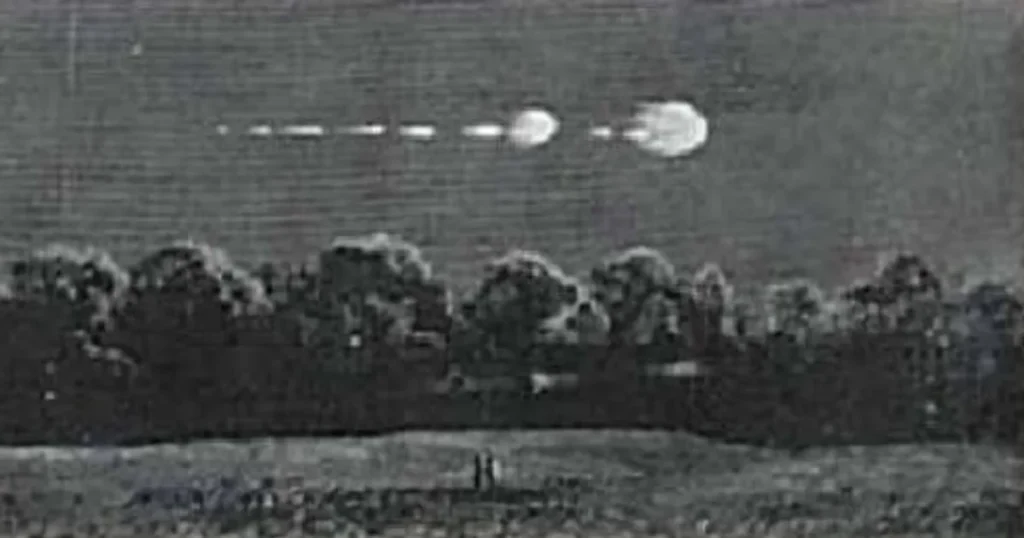
On a December night in 1876, only four days before Christmas, the people of Quincy looked into the winter sky and witnessed something few human beings have ever seen. Shortly before nine o’clock, an extraordinary light appeared in the heavens to the west. What followed was not an ordinary shooting star, nor even the brief flash of a solitary fireball. The object seemed to break apart before the eyes of those watching, becoming a procession of brilliant bodies moving together across the sky. For a few remarkable moments, the darkness above Quincy was transformed into a spectacle so unusual that, nearly 150 years later, the event remains one of the rarest recorded celestial phenomena in American history.
Today, the event is generally known as the Great Meteor of December 21, 1876, and it belongs to an exceedingly uncommon class of phenomena known as a meteor procession. Rather than plunging steeply into the atmosphere and vanishing almost immediately, an Earth-grazing object enters at a shallow angle, travels an immense distance through the upper atmosphere and may fragment into numerous glowing pieces that continue along approximately the same path. Physicist Donald Olson has identified four celebrated historical examples of such processions—in 1783, 1860, 1876 and 1913. The 1876 event was therefore no ordinary meteor shower. Quincy residents had witnessed a celestial occurrence rare enough to be measured not in years or decades, but in generations. (Wikipedia)
The meteor’s journey was astonishing in scale. Contemporary scientific accounts traced it eastward across Kansas, Missouri, Illinois, Indiana and Ohio, with its probable course continuing toward Pennsylvania and New York. J. Lawrence Smith, writing in the American Journal of Science after studying the event, described the bolide as being of “extraordinary magnificence” and placed the length of its observed path at roughly 1,000 to 1,100 miles—an immense glowing passage across the heart of the United States. Later accounts described the object breaking into numerous luminous fragments, estimates ranging from roughly twenty to as many as one hundred separate balls of light. What appeared over Quincy was therefore merely one magnificent portion of a spectacle unfolding across several states. (American Journal of Science)
Quincy happened to occupy a remarkable seat beneath that path. There were no weather satellites to detect the object, no smartphones to record it and no social media on which witnesses could immediately compare what they had seen. Instead, the evidence came from the most valuable scientific instruments available at that instant: human eyes. Residents who happened to be outdoors—or who were drawn outside by the extraordinary illumination—watched the procession pass over the region. From community to community, reports began accumulating. Some observers saw a great luminous body; others described multiple brilliant objects following one another. Elsewhere in the Midwest, witnesses compared the fragments to a flock moving together across the sky. The descriptions differed in detail, but the essential story remained the same: something enormous and spectacular had crossed the heavens.
A week later, the December 28, 1876, edition of the Quincy Weekly Whig preserved Quincy’s experience for posterity. The newspaper placed the phenomenon under language befitting what residents had seen, describing the event as a “Magnificent Display.” That surviving account is especially valuable because it places Quincy directly within the eyewitness record of the Great Meteor. The newspaper was not attempting to resurrect some distant legend decades after the fact. Its report appeared only seven days after the event, when memories were fresh and the strange sight remained a topic of conversation among those who had stood beneath it. For modern Quincy residents, that newspaper page serves almost like a window opened onto a December evening in 1876. (Quincy Public Library)
What made the sight so memorable was not simply brightness, but movement. A normal meteor may flash into existence and disappear almost before a witness can point toward it. The Great Meteor lingered long enough to be followed across an enormous portion of the country. Accounts collected afterward described brilliant fragments traveling in company, maintaining their eastward course as they crossed the sky. In some areas the procession was sufficiently bright to dominate the nighttime heavens, and later summaries described its leading body as brighter than the full moon, with numerous followers shining brilliantly behind it. To those standing beneath the display without modern knowledge of atmospheric physics, the appearance must have been almost incomprehensible: not a star falling from heaven, but an apparent formation of fiery objects traveling purposefully across it.
The event left behind more than newspaper stories. Near Rochester in Fulton County, Indiana, a meteorite fell on the same evening and became associated with the great procession. Scientific investigations recorded that fragments were recovered, and the Rochester meteorite is today officially recognized as an H6 ordinary chondrite. Nineteenth-century researchers quickly understood the importance of the fall. Professor Daniel Kirkwood gathered observations of the meteor’s passage, while scientists examined the recovered stone and attempted to reconstruct the object’s path through the atmosphere. The Smithsonian’s nineteenth-century collection eventually included a fragment of the Rochester meteorite. In that sense, a small physical remnant survived from the same extraordinary night whose fiery passage Quincy residents had watched overhead.
And then it was gone. The glowing fragments continued eastward, the heavens became dark again, and the people of Quincy were left to explain what they had witnessed. Newspapers carried reports. Astronomers collected observations. Scientists calculated trajectories and studied fallen material. Gradually, an event that must initially have seemed almost supernatural was placed within the developing science of meteors and meteorites. Yet scientific explanation has done little to diminish its wonder. If anything, knowing the scale of the phenomenon makes Quincy’s place in the story more extraordinary. The lights overhead were not a local curiosity. They were part of a celestial procession extending across a vast portion of the American continent.
Nearly a century and a half later, the December night of 1876 deserves a place among the most astonishing moments in Quincy’s history. Battles, fires, floods, elections and famous visitors have all filled the city’s newspaper columns, but occasionally history arrives from somewhere beyond the ordinary world altogether. On December 21, 1876, it came from the heavens. Quincy residents stepped beneath the winter sky and watched a great meteor fracture into a procession of fire as it raced eastward across America, one of only a handful of such events preserved in the historical record. The Weekly Whig called it a “Magnificent Display.” With the benefit of everything science has learned since, the description still seems difficult to improve upon.