
When the World Came to Quincy: The Skydiving Convention That Made Guinness World Records History
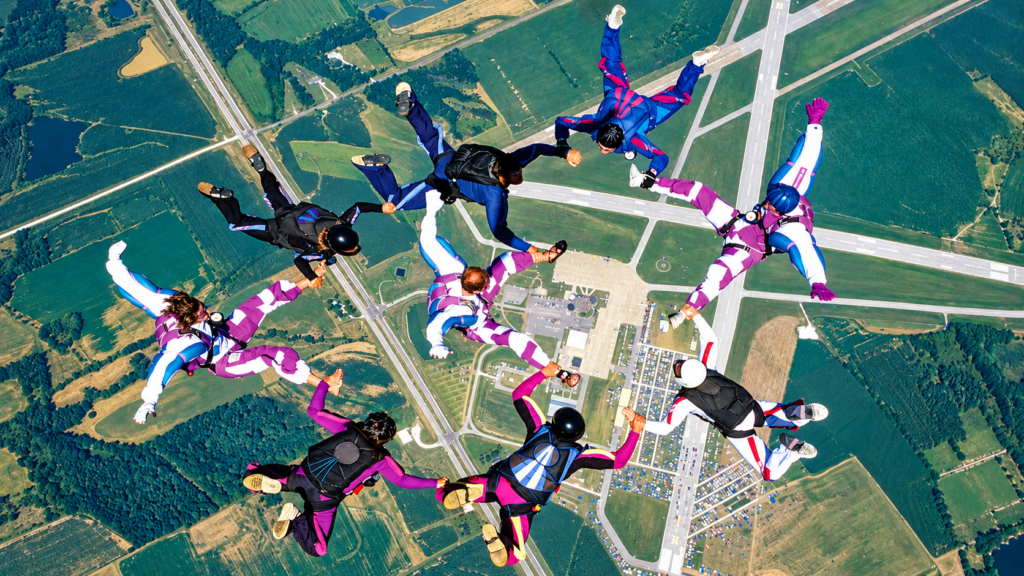
Photo by Mike McGowan (Used with Permission)
For years, thousands of skydivers from around the globe descended upon Quincy, Illinois, transforming a Midwestern airport into the epicenter of an international adventure sport. With the help of local aviation leaders, the World Freefall Convention became one of the most extraordinary events in Quincy’s history.
There was a time when the skies above Quincy, Illinois, were filled with thousands of colorful parachutes, the unmistakable roar of military aircraft and the excitement of visitors who had traveled halfway around the world to experience something truly extraordinary.
Every August, Quincy Regional Airport became the temporary home of thousands of adventurous men and women, drawn to the Mississippi River community for an event unlike anything else in the world.
They came from every corner of the United States and dozens of foreign countries. They jumped from passenger jets, historic World War II bombers, helicopters and military transport aircraft. They camped beneath the stars, filled local hotels, patronized Quincy businesses and introduced an international audience to a community that welcomed them year after year.
It was called the World Freefall Convention, and at its height, it was the largest gathering of skydivers anywhere on Earth.
In August 2000, the event reached a remarkable milestone when it earned a place in Guinness World Records.
Today, more than two decades after the last convention in Quincy, its legacy remains one of the most fascinating chapters in the city’s modern history.
How Quincy Became the Skydiving Capital of the World
The World Freefall Convention’s Quincy history dates to the 1980s, with local recollections placing its beginnings at Quincy Regional Airport in 1986.
The event’s best-documented period began in 1990, when Quincy native and aviation entrepreneur Don Kirlin developed the convention into an increasingly ambitious international gathering.
Kirlin, a 1972 Quincy High School graduate, was an accomplished pilot, aircraft mechanic, flight instructor and skydiver. His aviation experience and connections gave him access to an extraordinary collection of aircraft rarely available to recreational parachutists.
But transforming Quincy into an international skydiving destination required more than aircraft and ambition.
It required the cooperation of local aviation officials, city leaders, volunteers and businesses willing to support an undertaking of enormous logistical complexity.
Among those who helped make that possible was a respected Quincy aviation leader whose contribution deserves recognition.
Rogers Brenner: The Local Aviation Leader Who Helped Bring the World to Quincy
Franklin Rogers Brenner, known throughout the community as Rogers Brenner, played an important role in bringing the World Freefall Convention to Quincy.
Born in 1936, Brenner developed a passion for aviation as an adult, eventually becoming a corporate pilot, flight instructor, helicopter pilot and helicopter instructor.
In the early 1980s, he became manager of Quincy Municipal Airport. His experience and dedication to aviation positioned him to help Quincy accommodate an event that would eventually become internationally renowned.
Brenner’s obituary, published in the Quincy Herald-Whig following his death in September 2011, specifically recognized him as instrumental in bringing the World Freefall Convention to Quincy.
The convention required the airport to accommodate an extraordinary volume of aviation activity, including large aircraft, thousands of parachute jumps and extensive temporary facilities.
Brenner’s involvement represented the essential local cooperation that helped turn an ambitious idea into one of Quincy’s most recognizable annual attractions.
Although he later agreed with the decision to discontinue hosting the convention locally, his role in helping bring it to Quincy remains an important part of the event’s history.
For a man who loved flying and took considerable pride in serving his hometown, helping establish Quincy as an internationally recognized skydiving destination was a remarkable contribution to the community’s aviation heritage.
Don Kirlin, Rob Ebbing and an Extraordinary Vision
While Brenner helped establish the local foundation for the event, Don Kirlin became its principal organizer and promoter.
Kirlin worked alongside fellow skydiver Rob Ebbing and a dedicated organizing team to develop the convention into an international attraction.
A firsthand account published in the British skydiving magazine Sport Parachutist in 1994 identified Kirlin and Ebbing as the men behind the convention’s development during the early 1990s.
Their objective was ambitious: create a gathering where skydivers could experience aircraft, formations and activities unavailable at ordinary skydiving facilities.
Each year, the convention expanded its reputation, attracting increasingly large numbers of participants and introducing new aircraft and experiences.
Kirlin’s accomplishments eventually earned him induction into the Illinois Aviation Hall of Fame in 2022 and the International Skydiving Hall of Fame in 2024.
Both honors recognized the extraordinary impact of his work, including the convention that helped make Quincy famous within the international skydiving community.
The Year Quincy Made Guinness World Records History
The convention’s crowning achievement came during the summer of 2000.
From August 4 through August 13, Quincy hosted an astonishing gathering of skydivers whose collective accomplishments would earn international recognition.
According to Guinness World Records:
- 5,732 registered skydivers attended the convention.
- Participants represented 55 countries.
- More than 63,000 parachute jumps were completed during the ten-day event.
- On Friday, August 11, an extraordinary 8,104 jumps were recorded in a single day.
- Flight operations averaged approximately one every 1.08 minutes during that record-setting day.
The achievement was officially recognized by Guinness World Records under the category of Largest Freefall Event.
For ten days, a regional airport in western Illinois was handling the activity of an international aviation gathering on a scale unmatched anywhere else.
Aircraft repeatedly climbed into the sky carrying loads of skydivers. Parachutes opened above the airport in seemingly endless succession. On the ground, thousands of participants prepared for their next jumps.
The convention’s international reputation had become so firmly established that the name of a relatively small Illinois community was recognized by skydivers across the globe.
It was a remarkable achievement for the organizers, the airport and the city itself.
Famous Skydivers and International Personalities Came to Quincy
The World Freefall Convention attracted experienced skydivers, accomplished competitors, aviation personalities and internationally recognized pioneers of the sport.
Among them was Jerry Loftis, a well-known skysurfer from California.
Skysurfing involved performing aerial maneuvers while freefalling with a specially designed board attached to the feet.
Loftis had appeared in national advertising and entertainment productions, including work associated with Mountain Dew, HBO and Aerosmith’s music video Amazing.
He attended the 1998 convention, where he tragically died following parachute-deployment difficulties.
His participation illustrates the level of talent and international recognition represented among the convention’s attendees.
The event also attracted accomplished aerial photographers and videographers who documented spectacular formations above Quincy.
Among them was skydiving photographer Michael McGowan, whose photograph of a 14-person formation at the 1993 convention appeared on the cover of Parachutist magazine.
The images produced during those years remain valuable visual records of the convention’s extraordinary scale.
Spectacular Memories, but Not Without Tragedy
The World Freefall Convention was an adventurous gathering built around a sport that carries inherent risks.
Over the years, several serious accidents and fatalities occurred.
In 1986, two parachutists died following a midair collision near the ground during an earlier Quincy convention.
In 1998, internationally recognized skysurfer Jerry Loftis died after experiencing difficulties deploying his parachute.
These incidents were deeply tragic chapters in the event’s history and reminders of the dangers associated with skydiving.
A medical study examining the 2000 and 2001 conventions documented 117,000 skydives, 204 skydiving-related injuries requiring medical attention and one fatality during the study period.
The convention’s organizers and participants operated in a sport where training, preparation and safety procedures were essential.
The lives lost deserve remembrance, even as the convention’s broader history is recognized for its achievements and contributions.
Why Did the World Freefall Convention Leave Quincy?
By the early 2000s, the World Freefall Convention had grown into an enormous undertaking. Its popularity also created challenges.
Some residents and city officials expressed concerns about public disturbances, late-night activities, underage drinking and behavior associated with the convention’s nightlife.
Following complaints from the 2000 event, law enforcement increased its presence during the 2001 convention. The heightened security became a source of frustration for some participants and organizers.
A contemporary account published in the international skydiving magazine skyXtreme described the 2001 convention as a turning point.
Attendance declined sharply from the record-setting previous year, while tensions surrounding security and the atmosphere of Tent City became increasingly apparent.
Kirlin acknowledged that other communities were interested in hosting the convention. Following the 2001 gathering, the World Freefall Convention departed Quincy and relocated to Rantoul, Illinois, where it continued from 2002 through 2006. The convention was not held again after 2006.
Kirlin later explained that organizing the enormous event required nearly a full year of preparation. His responsibilities as an airline pilot and the growth of his aviation business, Air USA, made continuing the convention increasingly difficult.
In a 2022 interview, Kirlin expressed interest in the possibility of bringing the event back to Quincy.
He also recalled that the convention retained a strong association with its original home.
Even after relocating, its identity remained closely connected to Quincy.
An Extraordinary Chapter in Quincy’s History
For twelve consecutive summers from 1990 through 2001, the Kirlin-organized World Freefall Convention brought an extraordinary international spectacle to Quincy.
The event represented what could happen when aviation entrepreneurs, local airport leadership, community organizations and businesses worked together to support an ambitious vision.
Few communities of Quincy’s size can claim to have hosted the largest gathering in the world devoted to an international sporting activity.
Quincy can.
For those who remember standing beneath the summer sky and watching parachute after parachute descend toward the airport, the memories remain vivid.
For those too young to remember, the convention is a remarkable reminder of what this community once accomplished.
There was a time when the world came to Quincy, not because it was a major metropolitan destination, but because something extraordinary was happening here.
And for ten unforgettable days in August 2000, Quincy, Illinois, was officially home to the largest freefall event in the world.
That is a record, and a legacy, worth remembering.