

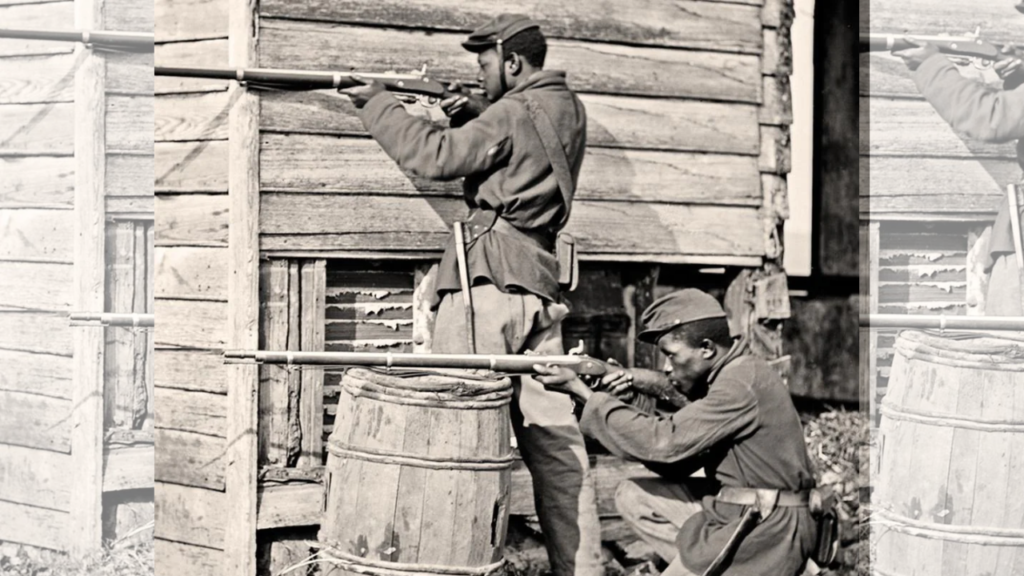
A Historical Look at Quincy’s Forgotten Black Civil War Regiment
More than 160 years ago, as slavery endured across the Mississippi River, Quincy became a place of refuge, opportunity and hope for hundreds of Black men and their families. Their arrival would help give birth to Illinois’ only Black Civil War regiment and leave a remarkable legacy of courage, compassion and community.
QUINCY, Ill. — As the Adams County Bicentennial Commission prepares to dedicate a plaque honoring the 29th United States Colored Infantry at 3:15 p.m. November 1st, Quincy Current is taking a look back at a remarkable chapter of local history — one that speaks not only to the courage of the men who served but also to the compassion and generosity found within the community that welcomed them.
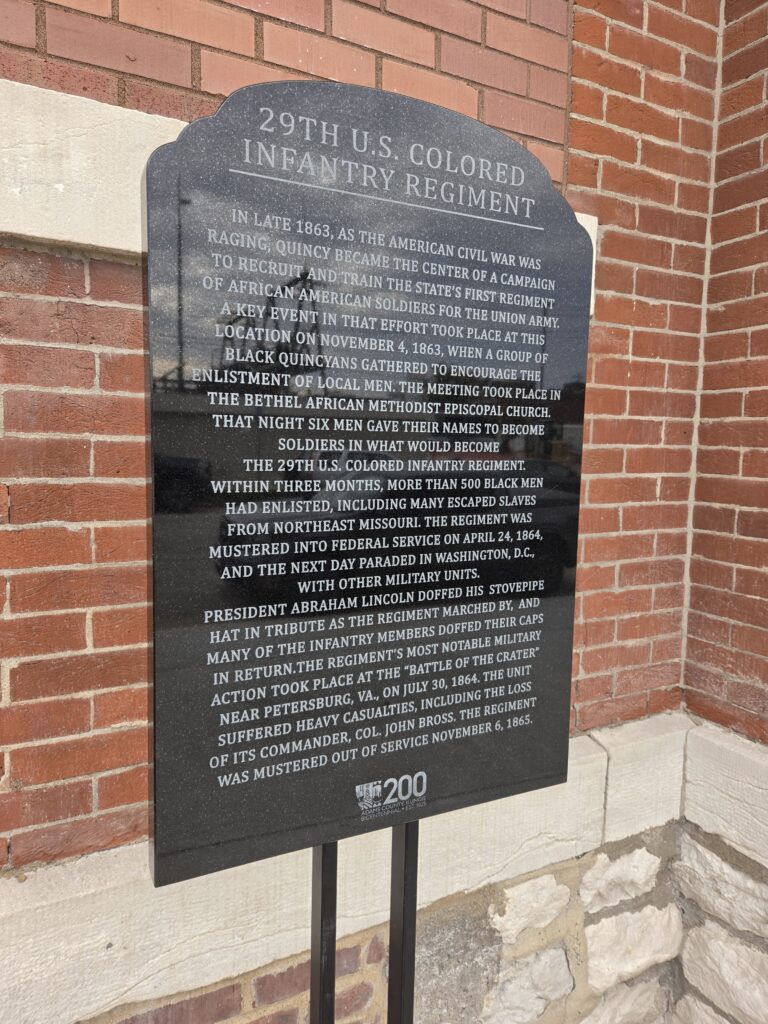
More than 160 years ago, as slavery continued just across the Mississippi River in Missouri, hundreds of Black men and their families arrived in Quincy seeking refuge, opportunity and the promise of freedom. What unfolded here would lead to the formation of Illinois’ only Black Civil War regiment and leave an enduring legacy of military service, sacrifice and a community’s willingness to extend a helping hand during one of the most consequential periods in American history.
In the closing months of 1863, as the Civil War divided a nation and slavery remained legal just across the Mississippi River in Missouri, hundreds of Black men began making their way to Quincy. Some had escaped enslavement. Others were free men seeking an opportunity to fight for a country that had long denied them the rights of citizenship.
For many, Quincy represented something that remained uncertain elsewhere: an opportunity for freedom, a measure of protection and the chance to build a different future for themselves and their families.
What unfolded in the riverfront community would become one of the most remarkable chapters in Quincy’s Civil War history. The city was selected as the organizing location for the 29th United States Colored Infantry, the only Black regiment raised in Illinois during the war.
Yet beyond its military significance, the regiment’s formation tells another story, one of a community whose churches, abolitionists, civic leaders and charitable organizations helped welcome and sustain men and families fleeing the institution of slavery.
It was a remarkable undertaking in a state where discriminatory laws still restricted the rights of Black residents.
A community with a history of offering refuge
Quincy’s connection to the struggle against slavery began decades before the first recruits of the 29th arrived.
Located along the Mississippi River directly opposite slaveholding Missouri, Quincy occupied a unique position in the nation’s growing conflict over slavery. Its geography made the city a natural destination for enslaved people seeking freedom, while its developing abolitionist network provided assistance to those making the dangerous crossing.
Among the city’s early abolitionists was Dr. Richard Eells, whose home at 415 Jersey St. became a documented stop on the Underground Railroad.
In August 1842, an enslaved man known as Charley escaped from Missouri by swimming across the Mississippi River. Upon reaching Quincy, he encountered Berryman Barnett, a free Black resident who helped guide freedom seekers through the city.
Barnett brought Charley to Eells, who attempted to transport him to the Mission Institute, an abolitionist institution east of Quincy. Their efforts were intercepted, Charley was captured, and Eells was prosecuted for assisting an escaped slave.
The incident, preserved through court records and the work of the Quincy Underground Railroad Museum, illustrates both the dangers of assisting freedom seekers and the willingness of some Quincyans to confront those dangers.
Importantly, the city’s abolitionist movement was not solely the work of white residents. Black Quincyans such as Barnett played an indispensable role, often risking their own security to help others escape bondage.
By the time the Civil War began, that tradition of assistance had helped establish Quincy as a destination for people seeking freedom.
An opportunity to serve
President Abraham Lincoln’s Emancipation Proclamation took effect Jan. 1, 1863, fundamentally changing the purpose and direction of the Civil War.
Although the proclamation did not immediately free enslaved people in Missouri, which remained loyal to the Union, it helped open the door for Black men to join the federal military.
In Quincy, the opportunity was embraced by members of the city’s established Black community.
On Nov. 14, 1863, Black residents gathered at the African Methodist Episcopal Church on Oak Street to discuss enlistment in the Union Army.
According to historical research by Reg Ankrom, published by the Historical Society of Quincy and Adams County, the meeting was marked by enthusiastic declarations of support for the Union and the abolition of slavery.
Those assembled pledged that they would rally around the nation’s flag and defend it against opposition.
Six men volunteered for military service that evening.
The gathering reflected a powerful determination among Black Quincyans to participate in securing the freedoms that the war increasingly represented. The effort also attracted support from white residents.
In September 1863, several prominent Quincy Republicans had sought federal authorization to organize a Black regiment in the city. Their efforts helped establish Quincy as the recruiting and organizing center for what would become the 29th United States Colored Infantry.
Illinois Gov. Richard Yates supported the regiment’s formation, motivated in part by a desire to ensure that Black recruits from Illinois counted toward the state’s military enlistment quotas.
The motivations behind the effort were not entirely altruistic. Nevertheless, the decision created an opportunity for hundreds of Black men to enter military service.
According to the Illinois State Archives, enrollment for the regiment began in Quincy in November 1863.
Hundreds arrive in Quincy
As recruitment expanded, men traveled to Quincy from communities throughout Illinois and neighboring Missouri.
Company A, commonly identified as the Quincy Company, was composed largely of men who had escaped slavery in Missouri’s Lewis, Marion, Pike and Ralls counties.
Many arrived with more than a desire to enlist. They brought wives and children, seeking to place their families beyond the immediate reach of those who had claimed ownership over them.
By Jan. 29, 1864, the Quincy Herald reported that approximately 500 Black men had gathered in the city for military preparation and training.
The growing number of recruits presented considerable logistical challenges. Housing, food, clothing and other necessities had to be provided while the men prepared for service.
Wooden barracks were established on property associated with abolitionist Dr. David Nelson and his Mission Institute, east of the city (near the present-day Lowe’s location).
The location carried particular historical significance.
Decades earlier, Nelson and his associates had helped establish Quincy as an important center of abolitionist activity. Now, land associated with that movement was being used to prepare Black soldiers to fight against the Confederacy.
For the men arriving from Missouri, the barracks represented more than military quarters. They were part of a community where the opportunity to serve the Union offered a possible path toward freedom.
The presence of accompanying families also placed new responsibilities upon Quincy residents, responsibilities that several local organizations willingly accepted.
A city extends a helping hand
Perhaps the most compelling evidence of Quincy’s acceptance of the soldiers can be found in how residents responded to the needs of their families.
While the men trained and eventually departed for military service, many wives and children remained behind in unfamiliar surroundings, often without established homes or reliable sources of income.
Local charitable organizations stepped forward.
The Freedmen’s Aid Society joined the Needle Pickets and the Sisters of the Good Samaritan in providing assistance to families of Black soldiers enrolled and trained in Quincy.
These organizations had already supported Union soldiers and their dependents throughout the war. Their work expanded to include families whose circumstances had been shaped by slavery and the uncertain transition toward freedom.
During the Great Western Illinois Sanitary Fair, held in Washington Square in October 1864, the Freedmen’s Relief Society organized fundraising activities specifically benefiting Black soldiers and their families.
According to research by historian Lynn M. Snyder, published by the Historical Society of Quincy and Adams County, the organization’s activities generated nearly $6,500 in direct donations.
The money helped accomplish something especially meaningful: providing homes for the families of Black soldiers and allowing them to remain together.
Funds were also used to expand Quincy’s African Methodist Episcopal Church, including the construction of a schoolroom in its basement.
The assistance addressed needs extending well beyond the battlefield. Families required shelter, children needed education, and newly freed people needed opportunities to establish independent lives.
John Wood, Quincy’s founder and former Illinois governor, also became involved in assisting approximately 200 Black refugees, including wives and children of men who had joined the regiment.
His involvement represented another important connection between the city’s established civic leadership and those seeking protection and a new beginning.
In a period when racial discrimination was embedded in law and everyday life, these efforts demonstrated that a portion of Quincy’s population was willing to translate its opposition to slavery into practical assistance.
Rather than simply providing a place for the regiment to assemble, residents helped sustain the families who had accompanied the soldiers.
Acceptance in an imperfect community
Quincy’s response, however, was not unanimous.
Illinois was a free state, but freedom did not guarantee equality.
The state’s notorious Black Laws prohibited African Americans from immigrating into Illinois and restricted their civil rights. Under legislation enacted in 1853, Black newcomers could face fines and other penalties simply for settling in the state.
Most of those laws remained in effect until 1865.
Political divisions within Quincy reflected the broader national conflict.
The Democratic Quincy Herald criticized the Lincoln administration’s policies involving Black soldiers, while the Republican Quincy Whig generally supported their enlistment.
Some recruits even encountered harassment and violence while traveling to Quincy.
The debate extended to military pay. Black soldiers initially received less compensation than white soldiers, an inequality challenged by supporters of the regiment.
In November 1863, the Quincy Whig called attention to the injustices Black residents had endured under Illinois law and urged equal military compensation for men serving their country.
The newspaper also encouraged Quincy officials to consider measures that would help equalize enlistment benefits for Black soldiers.
These competing attitudes reveal an important distinction in the city’s history.
Quincy was not a community free from racial prejudice. Nor was acceptance universal among its residents.
But within that divided community existed a network of people willing to offer shelter, opportunity, financial assistance and advocacy to individuals who had been denied those protections elsewhere.
Their actions helped distinguish Quincy as a place where the struggle for freedom was being supported in tangible ways.
From Quincy to the battlefields of Virginia
On April 24, 1864, the 29th United States Colored Infantry was formally organized in Quincy.
The regiment would eventually consist of 10 companies, drawing recruits from Illinois and other states.
Its men left for military service in the East, where they participated in the Union campaigns around Petersburg and Richmond, Virginia.
On July 30, 1864, the regiment fought in the devastating Battle of the Crater at Petersburg, suffering significant casualties during an unsuccessful Union assault against Confederate defenses.
Lieutenant Colonel John A. Bross, who had helped organize the regiment, was among those killed.
The soldiers continued serving through the final campaigns in Virginia, including operations surrounding the surrender of Confederate Gen. Robert E. Lee’s army at Appomattox in April 1865.
Their service did not end there.
The 29th was subsequently sent to Texas, where Union troops enforced federal authority following the Confederacy’s collapse.
The regiment was part of the military presence in Texas during the period surrounding the June 19, 1865, emancipation announcement in Galveston, the historical event commemorated today as Juneteenth.
The men were finally mustered out of federal service Nov. 6, 1865.
According to the National Park Service’s regimental history, 234 members of the regiment died during their service, including 46 officers and enlisted men killed or mortally wounded and 188 enlisted men who died of disease.
Behind those numbers were individual lives and families, including men who had come to Quincy from slavery in Missouri and left wearing the uniform of the United States Army.
A legacy larger than the regiment
More than a century and a half later, the 29th United States Colored Infantry remains an important part of Quincy’s history, not simply because of its military achievements but because of the circumstances that brought its men together.
The regiment’s organization demonstrated how a community along the Mississippi River could participate directly in the transformation of American society.
Black Quincyans organized meetings and volunteered to fight. Abolitionists provided a foundation of support established through decades of resistance to slavery. Civic leaders assisted displaced families. Charitable organizations raised money, provided housing and helped create opportunities for education.
Each contribution represented a different expression of the same principle: that people seeking freedom deserved more than sympathy. They deserved the opportunity to live with dignity.
The story should not obscure the racial discrimination that existed in Quincy or the prejudices that many African Americans continued to face long after the war. Those realities are essential to understanding the courage of the soldiers and the significance of the people who supported them.
Yet the historical record also preserves unmistakable acts of generosity and compassion.
In a nation bitterly divided over the meaning of freedom, hundreds of Black men found in Quincy an opportunity to serve, while their families found individuals and organizations willing to help them establish new lives.
The men of the 29th would go on to fight for the Union, endure extraordinary hardship and contribute to the defeat of the Confederacy.
But before they fought on the battlefields of Virginia, their story was already being written along the banks of the Mississippi River.
It was written in the determination of men who crossed from slavery toward freedom, in the generosity of neighbors who helped their families, and in the conviction that the promise of America ought to extend to those who had so long been denied it.