

Where Are Quincy’s Flock Cameras? A Look at the Network Ahead of City Council Report
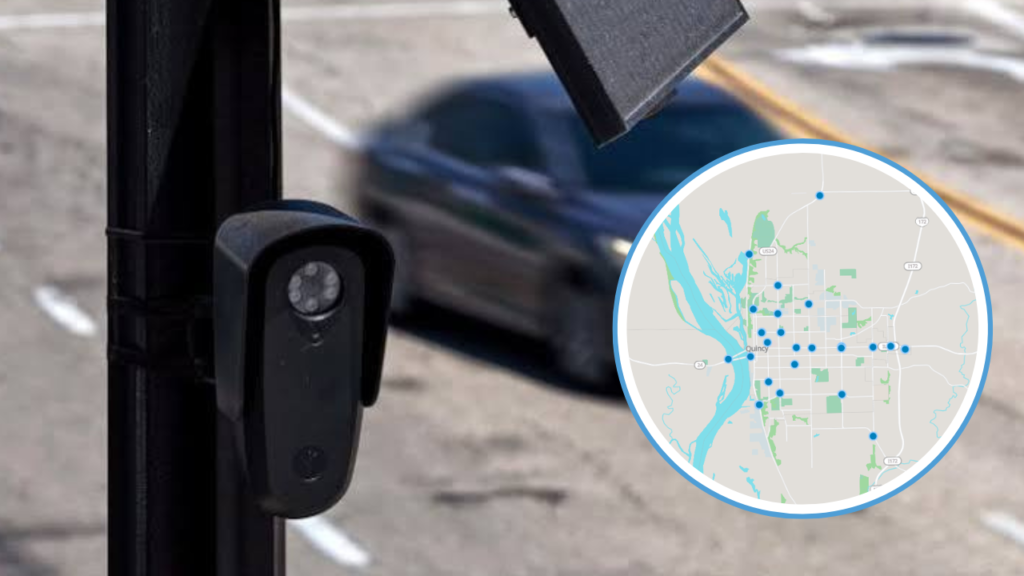
Public mapping projects show roughly two dozen automated license plate readers around Quincy, including cameras positioned near the Bayview and Memorial bridges and along several of the city’s busiest traffic corridors.
QUINCY, Ill. They are small enough that thousands of motorists likely pass them every day without noticing them.
Mounted along roadways throughout Quincy are automated license plate reader cameras, commonly known by the brand name Flock cameras. The devices photograph passing vehicles, read license plates and record information that law enforcement can later search as part of an investigation.
As debate over the technology grows both locally and nationally, Quincy residents will soon hear directly from the city’s police department about how the cameras are being used.
Interim Quincy Police Chief Mike Tyler is expected to address the Quincy City Council during its Tuesday, Sept. 8 meeting regarding the department’s use of Flock cameras and developments surrounding the technology. The meeting is being held Tuesday because Monday is Labor Day. The city’s formal agenda is generally published shortly before each council meeting.
Ahead of that discussion, Quincy Current took a closer look at a more basic question.
Where are the cameras?
Roughly 25 Cameras Mapped Around Quincy
A review by Quincy Current of the publicly accessible DeFlock mapping project shows approximately 25 automated license plate reader locations within Quincy and its immediate surrounding area.
Because DeFlock is a community-generated mapping project rather than an official City of Quincy inventory, the number should be considered approximate.
A separate database maintained by MyTownView, which incorporates DeFlock and OpenStreetMap information, currently lists 22 documented license plate reader locations within Quincy itself. It identifies both the Quincy Police Department and Adams County Sheriff’s Office as agencies associated with ALPR deployments in the area.
The mapped locations show that the cameras are not concentrated in one neighborhood.
Instead, they appear to form a network around some of Quincy’s primary routes into, out of and across the city.
Among the most noticeable locations are cameras positioned near both major Mississippi River crossings.
Mapped cameras appear near the Bayview Bridge, which carries traffic between Quincy and West Quincy, Missouri, and near the Memorial Bridge immediately south of downtown. Multiple camera points are mapped near those bridge approaches, placing license plate readers along two of the most heavily traveled gateways between Illinois and Missouri.
The public mapping data also shows several readers positioned along or near the Broadway corridor, extending from central Quincy toward the eastern edge of the city. Other mapped locations appear along north and south traffic routes and at points positioned to capture vehicles entering or moving through different sections of Quincy.
The pattern suggests that the network was designed less around monitoring individual neighborhoods and more around major transportation corridors where vehicles can be identified as they travel through the community.
Quincy Approved 20 Cameras in 2023
Quincy’s involvement with Flock dates to 2023.
In March of that year, the Quincy City Council unanimously approved a two-year agreement authorizing the police department to lease-purchase 20 fixed-location Flock license plate readers at an estimated cost of $117,600.
The resolution approved by the council described the cameras as taking still photographs of the rear of vehicles, including license plates, and stated that they did not use facial recognition technology.
The resolution also said data collected by the city’s cameras would belong to the Quincy Police Department and could be shared with outside law enforcement agencies for what the city described as a bona fide law enforcement purpose.
The city subsequently moved toward renewing the system. A September 2025 council agenda listed a proposed two-year contract for 20 fixed-location Flock cameras totaling $128,750.
Official committee minutes from that period show that privacy concerns were specifically discussed. Police officials said searches were auditable and that records existed showing who accessed the system and when. The department also told aldermen at the time that it had found no evidence that its data had been improperly handled.
Those assurances are likely to receive renewed scrutiny as the technology faces a much different national environment in 2026.
The National Debate Has Changed
Automated license plate readers were largely introduced to communities as investigative tools for locating stolen vehicles, finding wanted suspects, identifying vehicles connected with crimes and helping locate missing or endangered people.
Law enforcement agencies continue to point to those uses as significant benefits of the technology.
The controversy surrounding Flock, however, has intensified considerably.
Recent investigations around the country have documented cases in which law enforcement officers were accused of using automated license plate reader systems for personal purposes, including searching for former romantic partners or other individuals outside legitimate investigations.
A Washington Post investigation published in August identified at least 50 law enforcement officers who had been charged with or accused of misusing Flock or other automated license plate reader systems. Some cases involved officers allegedly using the technology to monitor former partners or romantic interests.
More recently, records examined by WIRED detailed a case involving a Georgia police officer who repeatedly searched Flock data associated with a former romantic partner and another officer. The officer later resigned following an internal investigation.
Those cases are serious and increasingly well documented, although it would be inaccurate to characterize documented misuse as literally occurring every day.
The broader concern is whether a powerful investigative tool that can reconstruct portions of a vehicle’s movements has sufficient safeguards to prevent an authorized user from searching for someone for an unauthorized reason.
Flock Responds With New Safeguards
Flock Safety has responded to the controversy by announcing additional restrictions and auditing tools intended to identify misuse.
The company says searches are logged and reviewable and that access is limited to authorized users. Flock has also introduced requirements involving offense types and case codes and an auditing system designed to identify atypical search behavior.
In August, Flock announced additional privacy changes, including recommending a shorter default retention period of seven days for new implementations and creating a system through which particular records can be preserved as evidence when necessary.
Flock’s existing standard policy has generally provided for license plate data to be deleted after 30 days, subject to applicable laws and individual customer agreements.
The company maintains that ALPR cameras capture vehicle and license plate information rather than facial recognition or driver identification and that individual law enforcement agencies control access to their information.
Debate Reaches Across the River
The discussion is not confined to Quincy.
Earlier this week, Ralls County Sheriff Brian Allen announced that his department had suspended operation of its Flock cameras until he receives answers from the company about data retention, access and whether information obtained through the system is sold.
Allen said he remained supportive of using the technology for legitimate public safety purposes but wanted additional information before allowing the cameras to resume operation.
The action just across the Mississippi River places additional attention on what Quincy officials will say about their own system.
Public Safety Versus Public Oversight
The debate surrounding Flock cameras is ultimately more complicated than whether the technology works.
There is substantial evidence that automated license plate readers can provide investigators with information that would be extraordinarily difficult to obtain through conventional policing alone.
There is also growing evidence that access to such systems creates opportunities for misuse when policies, supervision or auditing fail.
Those two realities can exist simultaneously.
The question facing Quincy is therefore not simply whether Flock cameras should exist.
Residents may also want answers about who can search Quincy’s camera data, what constitutes an authorized search, how searches are audited, what happens when an employee violates policy, which outside agencies can search Quincy-generated information, how long the information is retained, and whether the public can periodically review meaningful statistics showing how the system is being used.
Those questions have become increasingly important as a network of roughly two dozen cameras quietly records vehicle traffic across Quincy’s major roadways.
On Tuesday night, the discussion moves back to City Hall.