

When Quincy Helped Feed America: The Rise and Fall of Egg-O-See
At its height, a cereal company operating along Quincy’s riverfront was shipping millions of packages, consuming nearly 100,000 pounds of wheat each day and claiming an output larger than any competing cereal producer in the world.
QUINCY, Ill. Long before grocery store cereal aisles were dominated by names such as Kellogg’s, General Mills and Post, millions of green boxes carrying an unusual name were being shipped across the country from a factory along the Mississippi River in Quincy.
The cereal was Egg-O-See, and for a remarkable period in the early 20th century, Quincy was home to one of the largest breakfast cereal operations in the United States.
Its factory stood at 111-139 South Front Street, where an enormous amount of wheat passed through the plant each day before leaving Quincy aboard railcars filled with packaged cereal.
At its peak, the company reported production figures that were extraordinary even by the standards of Quincy’s industrial era. In July 1905 alone, approximately 1.8 million packages of Egg-O-See were shipped from the operation.
By December 1906, company officials were claiming that Egg-O-See was being produced in greater quantities than any other cereal in the world.
For a city already filled with factories, foundries, breweries and manufacturers, it was another example of a Quincy that once produced goods recognized far beyond western Illinois.
From Battle Creek to Quincy
The story did not begin in Quincy.
Its origins can be traced to Battle Creek, Michigan, a city that would become almost synonymous with the American breakfast cereal industry.
There, drugstore owner and city alderman John Linihan developed a wheat flake cereal that was sprayed with apple jelly. The product became associated with the Battle Creek Cereal Food Co., incorporated in 1901. The business soon underwent a series of name changes, first becoming Cero-Vito and later the Cero-Fruto Co.
Linihan eventually sold his interest and helped organize another venture, the Battle Creek Breakfast Food Co. Limited, which was incorporated on Feb. 18, 1902.
Only a few months later, the company’s attention turned toward Quincy.
In April 1902, company officer F.E. Kelsey traveled to the city to examine the former Taylor Milling Co. plant owned by Proctor Taylor.
The facility proved suitable.
The company acquired the property, but the transaction became more than the relocation of a manufacturing operation. Quincy businessmen ultimately acquired more than half of the company itself.
The resulting leadership had deep local ties. John W. “Jack” Cassidy served as president, Loring P. Wheeler as vice president, Proctor Taylor as secretary and Richard F. Newcomb as a director. Linihan remained closely involved as treasurer and general manager.
Quincy had effectively entered the rapidly expanding breakfast cereal business.
The Green Box Called Egg-O-See
Although Egg-O-See is sometimes remembered as the name of the company, it was actually the name of its signature cereal.
The Battle Creek Breakfast Food Co. placed its first Egg-O-See product on the market on March 17, 1903.
The St. Patrick’s Day debut was particularly fitting because Egg-O-See was packaged in a distinctive green box that would become one of the product’s most recognizable features.
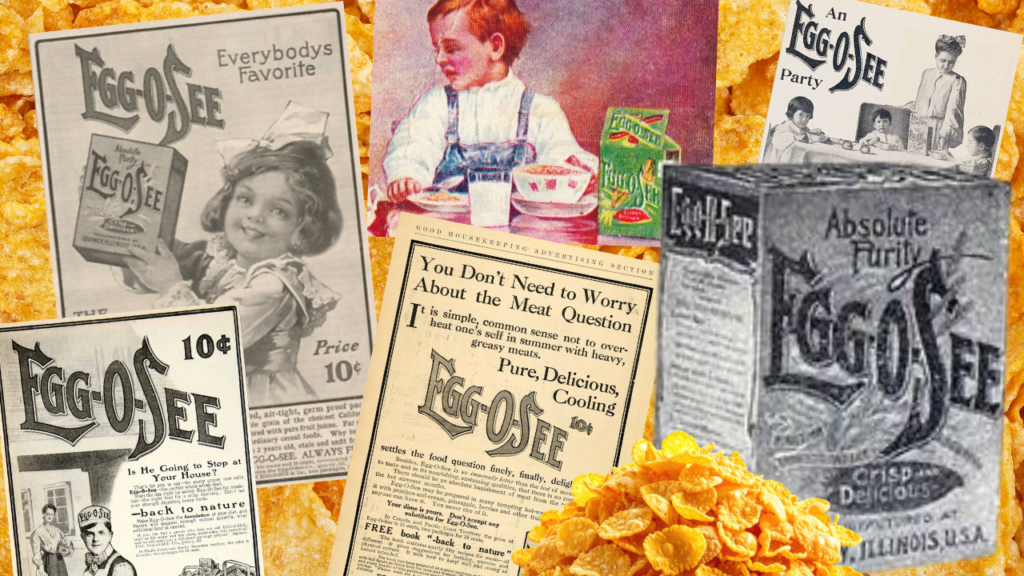
Its packaging promoted the cereal with phrases including “Absolute Purity,” “Made from Choicest Wheat” and “Crisp and Delicious.”
Egg-O-See itself was a wheat flake cereal.
The exact origin of its unusual name remains less certain.
An explanation appeared years later in the Quincy Daily Herald. According to the story, a traveling salesman eating breakfast at a northern hotel asked a Swedish waitress whether breakfast cereal was available. Her response that she would “go and see” was supposedly heard by the traveler as something resembling “Egg-O-See.”
The salesman allegedly began using the expression whenever he ordered cereal, and the unusual phrase eventually became the product’s name.
Whether the account represented the actual origin of Egg-O-See or simply clever early advertising is less clear, but the name became nationally recognizable.
Millions of Boxes Leaving Quincy
Egg-O-See grew rapidly.
By July 1905, the Quincy operation was shipping approximately 1.8 million packages in a single month.
The factory reportedly had the capacity to produce eight railcar loads each day, amounting to approximately 86,400 packages.
To sustain that production, roughly 96,000 pounds of wheat were processed every day.
The scale became even more striking in 1906.
That year, the company placed what was described at the time as the largest packaging order ever made. The order called for 100 million Egg-O-See cartons.
Producing enough packaging to fill the order reportedly required approximately 100 railroad boxcars.
The familiar green boxes were destined for grocery shelves throughout the country.
At the company’s December 1906 annual meeting, officials reported that Egg-O-See production exceeded that of any other individual cereal in the world.
Such claims were promotional and originated with the company itself, but the production figures leave little doubt that Quincy’s cereal operation had become a major force in the young packaged-breakfast industry.
Big Enough to Affect the Quincy Post Office
Egg-O-See’s presence was felt beyond the factory.
The company became such a prolific user of the postal system that its mailings reportedly accounted for approximately one-seventh of the total receipts of the Quincy post office in 1907.
For a community already home to a remarkable variety of industries, a single manufacturer accounting for such a significant portion of postal business illustrates just how extensive the company’s marketing and distribution operation had become.
Advertising was essential to the cereal industry.
Egg-O-See advertisements appeared extensively in newspapers and magazines, while the company distributed promotional materials bearing the brand’s name and distinctive imagery.
Many of those advertising pieces survive today as collectibles, remnants of a brand once familiar to American consumers.
Egg-O-See Expands
The original wheat cereal remained the company’s best-known product, but management soon expanded its offerings.
By late 1906, the company had entered the increasingly competitive corn flake market with E-C Corn Flakes Toasted.
Other products included Washington Crisps, Fruited Wheat and Fruited Oats.
Expansion also came through acquisitions.
Among the businesses eventually absorbed by the company was Cero-Fruto, the earlier cereal venture with which Linihan had been associated.
In 1905, the company acquired the large Hygienic Food Co. plant in Buffalo, New York.
Following that acquisition, the company promoted the combined production of its Quincy and Buffalo operations as greater than the output of any four other cereal companies in the country.
For a time, Egg-O-See appeared positioned to become one of the enduring names of American breakfast.
Instead, rapid expansion created problems that enormous sales figures could not conceal.
An Empire That Struggled to Make Money
Despite the tremendous volume of cereal leaving its factories, the company struggled financially.
Its corporate offices moved repeatedly during the period, relocating to Chicago in January 1907, returning to Quincy in 1909, moving back to Chicago in 1911 and finally returning again to Quincy in May 1915.
More serious problems surfaced in 1908.
After several years of aggressive expansion without corresponding profitability, Egg-O-See was placed in the hands of creditors that September.
A court appointed Linihan, who had served as general manager, as receiver.
Within approximately a year, the company had regained enough stability for the court to return active control.
New investors arrived in early 1910, when Eastern financial interests acquired stakes in the business.
The company was subsequently reorganized under a new name, United Cereal Mills Inc.
The cereal continued to be produced, but the enormous growth of its early years was over.
The End Came in 1921
During the company’s second decade, changes in management and continued business difficulties gradually weakened the operation.
In September 1921, the company closed.
The Quincy property belonging to United Cereal Mills was eventually sold for approximately $50,000, a fraction of the investment that had been poured into the enterprise during its years of expansion.
An industry that had once shipped millions of boxes from the Quincy riverfront disappeared.
The green Egg-O-See boxes disappeared from grocery shelves as well.
Other cereal manufacturers ultimately became household names, while Egg-O-See faded largely into history.
A Different Industrial Quincy
It can be difficult today to envision just how industrial Quincy once was.
Factories lined portions of the riverfront. Railroads carried locally manufactured goods across the country. Thousands of residents worked in industries producing everything from agricultural machinery and stoves to beer, shoes and packaged foods.
For a brief but remarkable period, breakfast cereal belonged on that list.
Nearly 100,000 pounds of wheat could pass through the Egg-O-See operation in a single day. Millions of packages left Quincy in a single month. One order required 100 million cereal cartons.
The company ultimately failed to turn its enormous production into lasting financial success, but its story provides another glimpse into an era when products manufactured along the Mississippi River in Quincy could find their way into homes throughout the United States.
Today, Egg-O-See is largely remembered through old newspaper advertisements, surviving cereal boxes and promotional collectibles.
More than a century ago, however, those green boxes were rolling out of a massive plant on South Front Street by the railcar load.
And for a time, one of the biggest names in the American breakfast business called Quincy, Illinois, home.
It Happened in Quincy: This article is part of a Quincy Current history series revisiting the businesses, industries, landmarks and institutions that once helped shape Quincy.