
A River on Fire: The 1969 Disaster That Reached the Quincy Waterfront
When Fire Came Down the Mississippi: The 1969 Barge Disaster That Reached Quincy
LA GRANGE, Mo. More than half a century ago, a fire on the Mississippi River began at a fuel terminal in La Grange and, within hours, became a threat to Quincy.
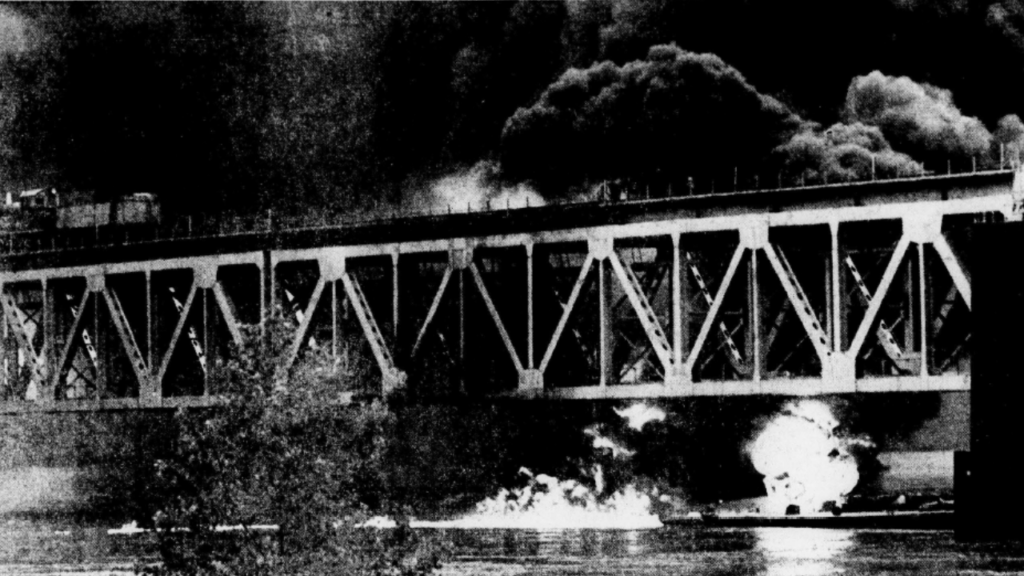
The disaster of May 12, 1969, did not remain confined to one dock or one Missouri river town. Burning barges broke loose, drifted downstream and spread fire along the river. One gasoline barge traveled about eight miles before becoming lodged against the Chicago, Burlington and Quincy railroad bridge near Quincy, where it burned beneath the structure for hours.
By the time the tragedy was over, six men had died.
Federal investigators later determined that the disaster began aboard tank barge MOS 106 at the Triangle Oil Refining Co. loading facility at La Grange. The National Transportation Safety Board said the barge caught fire and exploded at about 9:15 p.m. May 12 while gasoline was being unloaded. Tank barge MOS 104 and the towboat M/V Martin were also at the facility and became involved in the fire.
What followed was a rapidly developing emergency that connected La Grange and Quincy in a way few residents could have expected that night.
The federal investigation found that the M/V Martin had arrived with barges MOS 104 and MOS 106 after the barges were loaded at West Memphis, Arkansas. MOS 106 had originally taken on about 908,000 gallons of gasoline. Investigators also documented that roughly 40,000 gallons of gasoline salvaged from previously damaged tanks had been transferred into several tanks aboard MOS 106 before the La Grange unloading operation.
During the unloading process, a strong gasoline odor was noticed about 15 minutes before the first explosion. A fire then started near the barge and was followed by a series of explosions. Burning gasoline spread across the vessels and surrounding area.
The force of the explosions and fire ruptured portions of MOS 106 and spread burning gasoline onto nearby vessels. The M/V Martin, MOS 104, the terminal barge and other vessels were caught in the developing fire. A grain elevator was also ignited.
The federal report said burning and drifting vessels threatened not only the La Grange facility but eventually the Quincy waterfront and the railroad bridge. Investigators estimated that approximately 270,000 gallons of gasoline were burned or lost into the Mississippi River during the casualty.
As the situation worsened, part of the burning tow broke loose and moved downstream with the current.
MOS 106, still burning intensely, eventually lodged against the upstream side of the Chicago, Burlington and Quincy railroad bridge near Quincy. The Quincy Herald-Whig reported that the burning barge had traveled about eight miles downriver before reaching the bridge at approximately 12:30 a.m. May 13.
The sight that greeted Quincy residents that morning was extraordinary.
Flames and thick black smoke rose beneath the railroad bridge. The Herald-Whig reported that the barge continued burning for nearly 12 hours and was positioned crossways against the bridge just west of the main navigation channel. The newspaper reported that the barge contained approximately 847,000 gallons of gasoline when it became lodged there.
Railroad workers tried to protect the structure. A standby locomotive and crew sprayed water onto the bridge ties during the early hours of the emergency. Heavy smoke and fire initially made it difficult for railroad officials to determine how much damage had been done.
The federal investigation described the situation as a serious threat to the Quincy waterfront if the burning barge became dislodged from the bridge.
That possibility complicated the firefighting effort. Quincy firefighters had equipment for land-based operations, but fighting a gasoline fire beneath a railroad bridge from the river required a different approach. Coast Guard personnel and equipment were sent from St. Louis, while local, railroad and federal officials coordinated their response.
Firefighters eventually approached the burning barge from the river aboard another barge. According to the federal report, eight Coast Guardsmen from St. Louis and six Quincy firefighters applied approximately 275 gallons of foam. The fire was extinguished at about 12:50 p.m. May 13.
The MOS 106 remained against the bridge until the evening of May 14, when it was removed and taken about two miles upstream for the remaining gasoline to be safely unloaded.
While Quincy faced the dramatic sight of a burning gasoline barge beneath one of its railroad bridges, the human cost of the disaster was being measured upriver.
Early reporting on May 13 said five men were feared dead. The bodies of Glenn Maples and Albert Frieden, both associated with the Triangle Oil operation in La Grange, had already been recovered. Maples’ body was found in the Mississippi River near the explosion site, while Frieden was found caught in cables at the dock.
Several other men were still missing.
The final toll would reach six.
According to the Coast Guard’s casualty investigation, the men who died were:
William R. Opitz, master of the M/V Martin. Opitz survived the initial disaster but suffered severe burns. He died at St. Mary’s Hospital in Quincy on May 16, 1969.
Walter C. Mitchell, who was identified in the federal investigation as a tankerman associated with the Triangle Oil operation.
Albert Frieden, a terminal assistant for Triangle Oil Refinery Co. in La Grange.
Louis Haganhoff, a truck driver who was at the La Grange facility when the explosions occurred. (In articles reported after the tragedy, incorrectly reported his name as Lewis)
Aaron Jean, a deckhand aboard the M/V Martin from Alton, Illinois.
Glenn H. Maples, a Triangle Oil refinery manager in La Grange.
Contemporary newspaper coverage initially listed Mitchell, Jean and Haganhoff among those missing. The Herald-Whig reported that Haganhoff’s truck remained near the refinery dock with the keys in the ignition and its cab windows down after the explosion.
The newspaper also reported four men receiving treatment in Quincy hospitals immediately after the disaster. Opitz was admitted to St. Mary Hospital in serious condition with second-degree burns over much of his body. Larry Thompson, Orrin T. McPherson and William R. Morrison were also treated in Quincy.
Opitz later became the sixth fatality when he died from his burn injuries.
Days after the explosion, the work of recovering the missing men and damaged equipment continued at La Grange. On May 22, the Herald-Whig reported that crews were attempting to raise the sunken Triangle Oil fuel dock. Officials believed that the bodies of two men still missing could be trapped beneath it. By then, the newspaper was reporting the final total of six dead.
The recovery effort itself was difficult. Workers deliberately sank a larger barge beside the damaged dock, secured the two together and then pumped water from the larger vessel in an effort to lift both. An earlier attempt had raised one end of the dock by about 20 inches, but much of it remained submerged.
The federal investigation eventually turned from the immediate tragedy to the question of why it happened.
The National Transportation Safety Board concluded that the probable cause was gasoline spilled on the deck of MOS 106. Investigators determined that the spill created an explosive gasoline vapor and air mixture that was ignited by the galley range aboard the nearby M/V Martin.
Investigators listed several contributing factors, including the transfer of salvaged gasoline into several tanks aboard MOS 106, conditions created during unloading, possible pressure buildup or movement of gasoline between tanks, and the lack of practical standards limiting how full the tanks could be.
The federal report also cited the presence of the M/V Martin and possible ignition sources beside the barges, the failure to determine the source of gasoline vapors, the failure to eliminate those vapors in time and the failure to keep tank hatch covers securely closed.
The report stated that the deaths resulted from the violent release of energy when the explosive vapors ignited, the spread of burning gasoline from ruptured drums and the movement of burning vapors across the Martin and floating dock.
The investigation led to recommendations for better training and clearer standards for loading tank vessels carrying dangerous cargo.
For Quincy, however, the event was more than a marine accident occurring several miles upriver.
The disaster arrived at the city’s doorstep in the darkness.
Residents awoke to smoke rising beside a railroad bridge and firefighters confronting a burning gasoline barge on the Mississippi. The photographs published by the Herald-Whig captured flames beneath the bridge while railroad workers stood above trying to protect the structure. The newspaper’s chief photographer, Jerry Ostermueller, photographed the scene from Bay Island, and some of those images were distributed nationally by The Associated Press.
The bridge survived. The fire was extinguished. The drifting vessels were brought under control.
Six men did not return home.
That is ultimately what gives the disaster its place in the history of Quincy and the Mississippi River. The photographs show fire, smoke and an endangered bridge, but the deeper story is found in the names left behind.
Their deaths turned a river accident into a regional tragedy, one that began on the Missouri shore and traveled downstream until the people of Quincy could see its flames for themselves.