
Is Quincy Losing Its Sense of Community? Upcoming Film Asks a Question Worth Considering
With debates over school funding, homelessness and public discourse shaping local conversations, a free documentary screening at City Hall explores what holds communities together — and what happens when those connections begin to weaken.
QUINCY, Ill. — There was a time when much of American community life revolved around something relatively simple: showing up.
Neighbors gathered at churches, volunteered with civic organizations, participated in service clubs, attended public meetings and spent evenings in the company of people who did not necessarily share their opinions but shared something equally important — a community.
Today, those connections are increasingly the subject of concern across the country. And in Quincy, where questions about public spending, community responsibility and the role of local government have prompted sometimes difficult conversations, a forthcoming documentary offers an opportunity to examine what it truly means to belong.
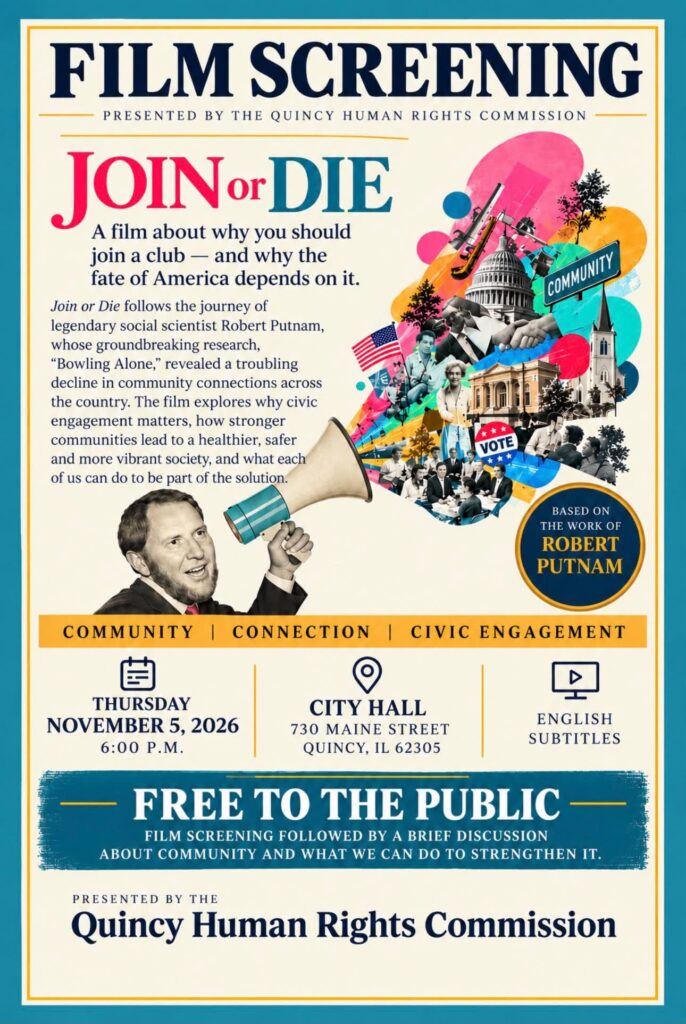
On Thursday, Nov. 5, the Quincy Human Rights Commission will present a free public screening of Join or Die, a critically acclaimed documentary examining the decline of civic participation in America and the consequences of a society in which fewer people feel connected to one another.
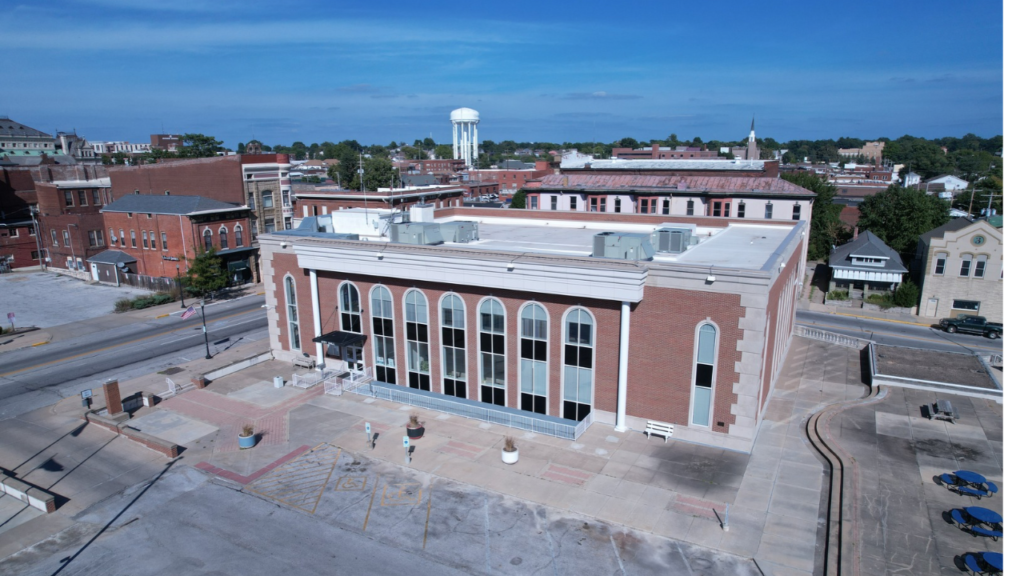
The screening begins at 6 p.m. at Quincy City Hall, 730 Maine St., and will be followed by a brief discussion about community and ways to strengthen it.
The timing is particularly relevant.
In recent months, Quincy residents have been engaged in public discussions over issues that touch nearly every corner of community life.
A proposed 1% countywide school facilities sales tax, appearing on the Nov. 3 ballot, has prompted debate about education funding, taxpayer responsibility and the future of local schools. Supporters point to the need for improved facilities and educational resources, while critics have questioned whether additional taxation is the appropriate solution.
The debate has also brought residents together for public meetings, informational sessions and discussions, precisely the kind of civic participation examined in the documentary.
Elsewhere, discussions surrounding homelessness and a proposed ordinance addressing encampments have raised difficult questions about public safety, compassion and the responsibilities of local government toward vulnerable residents.
In October, the Quincy Human Rights Commission itself adopted a resolution calling upon city leaders to encourage respectful civic discourse, protect freedom of expression and affirm the dignity of community members. The action followed controversy over remarks regarding Islam attributed to a Quincy alderman.
These issues are distinct, and residents can reasonably disagree about their solutions. Yet each presents a similar underlying question: How does a community navigate its differences without losing the relationships and mutual responsibilities that hold it together?
That question lies at the heart of Join or Die.
A documentary about more than joining clubs
Directed by Pete Davis and Rebecca Davis, the documentary follows Harvard political scientist Robert Putnam, whose influential book Bowling Alone examined the decline of civic participation and social connections in American society.
Putnam’s research popularized the concept of “social capital,” the value created through relationships, trust and participation in community institutions.
His work suggests that these connections are not merely social conveniences. They can influence public health, civic participation, cooperation and the ability of communities to address shared challenges.
The documentary examines why Americans have become less involved in traditional organizations and what that decline could mean for the future of the country.
Featuring interviews with public figures, researchers and community organizers, the film explores how ordinary associations — from recreational clubs to volunteer organizations, can strengthen the bonds between people who might otherwise remain strangers.
The film has earned a 95% critics’ score on Rotten Tomatoes, based on 20 published reviews, and has received attention for its examination of civic life at a time of increasing social isolation.
Its central argument is straightforward: Strong communities do not happen automatically. They depend upon people choosing to participate.
What does that mean for Quincy?
For generations, Quincy has maintained a substantial network of churches, charitable organizations, neighborhood institutions and volunteer groups.
Organizations such as Quincy Service League, the United Way of Adams County and numerous religious congregations illustrate the longstanding role that voluntary service plays in the community.
That tradition remains visible today.
In June, the United Way of Adams County’s annual Day of Caring brought together volunteers from 18 local businesses and one service organization to complete 20 community service projects. Their work included landscaping, painting, organizing donations and improving facilities serving local residents.
Such efforts demonstrate that civic involvement remains an active part of life in Quincy.
But the existence of strong organizations does not necessarily answer whether residents feel as connected to one another as previous generations did.
Do younger residents have the same opportunities to develop meaningful community relationships? Are churches, service clubs and volunteer organizations successfully engaging new generations? Are neighbors spending more time together, or increasingly experiencing their communities through social media?
And perhaps most importantly, are residents still willing to work alongside people with whom they disagree?
These are questions worth asking in a city whose future depends not only on economic development, public infrastructure and government decisions, but also on the strength of relationships among its residents.
Disagreement does not have to mean division
The documentary’s message does not require everyone to think alike.
In fact, productive disagreement is an essential part of civic life.
Residents can hold opposing views on taxes, public policy, religious questions and government priorities while still sharing a commitment to the welfare of their community.
A healthy civic culture provides opportunities for those disagreements to be expressed, examined and debated without reducing neighbors to political adversaries.
For Quincy, the upcoming screening may offer an opportunity to move beyond the disagreements themselves and consider the relationships that make constructive public discussion possible.
The challenge is not necessarily eliminating differences. It is ensuring those differences do not prevent residents from recognizing their shared interests and responsibilities.
Part of a broader statewide effort
The Quincy screening is also listed as part of the Illinois Commission on Discrimination and Hate Crimes’ Join to Stop Hate State Tour, an initiative intended to strengthen social connections and encourage a sense of belonging in communities throughout Illinois.
The initiative uses screenings of Join or Die and accompanying discussions to examine how community involvement may help reduce social isolation, strengthen trust and foster more constructive relationships.
The statewide tour is scheduled to continue into spring 2027.
For the Quincy Human Rights Commission, the local event offers an opportunity to bring residents together in a setting where the focus is not a particular ordinance, election or political position, but the broader importance of civic life.
Whether the screening produces lasting change will depend, in part, on whether participants carry its message beyond City Hall.
After all, belonging to a community requires more than living within its boundaries.
It requires participation, an investment in others and a willingness to contribute to something larger than oneself.
Quincy has a long history of neighbors helping neighbors, churches serving those in need and volunteers devoting their time to causes they believe will benefit future generations.
The question raised by Join or Die is whether those traditions will continue to flourish in an increasingly disconnected age.
And perhaps the most important lesson is that the strength of a community cannot be measured solely by the number of people who live there, the businesses it attracts or the buildings it constructs.
It can also be measured by how its people treat one another, particularly when they disagree.
The film screening is free and open to the public. Join or Die will be shown Thursday, Nov. 5, at 6 p.m. at Quincy City Hall, 730 Maine St. The film includes English subtitles, and a brief community discussion will follow.
For those who attend, the evening offers more than an opportunity to watch a documentary. It provides a chance to consider an important question about the city they call home:
What kind of community do we want Quincy to be — and what are we personally willing to do to make it that way?