

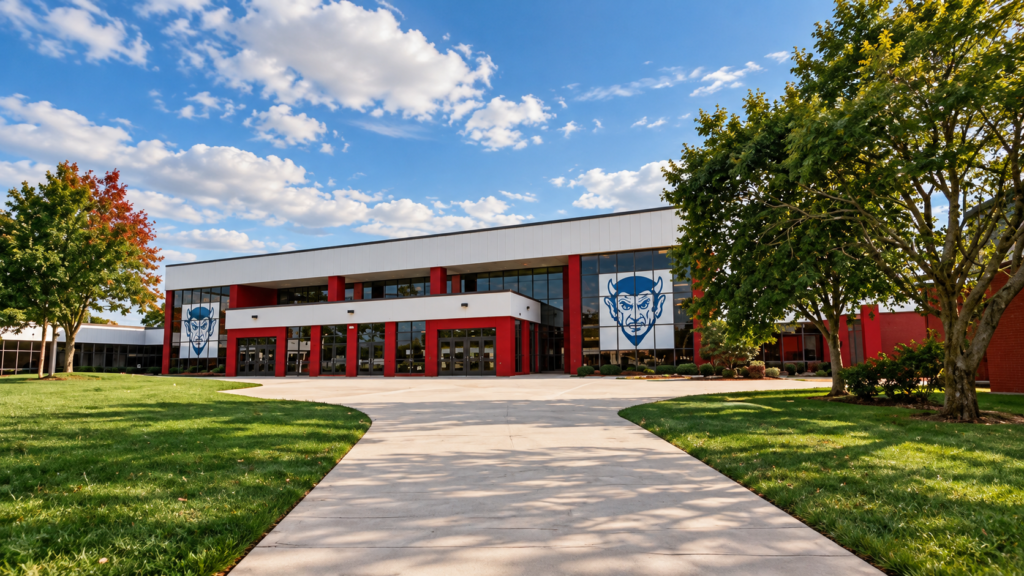
The QHS Attendance Crisis: Years of Plans, Little Progress: Quincy Battles a Severe Absenteeism Problem
Quincy Senior High School’s 42.6% chronic absenteeism rate far exceeds the Illinois average and most neighboring high schools, while district records show QPS has already spent years identifying, monitoring and attempting to address the problem.
QUINCY, Ill. — More than four out of every 10 students at Quincy Senior High School were chronically absent during the 2024-25 school year, according to the latest Illinois State Board of Education data, placing QHS far above the statewide average and among the highest rates found in a Quincy Current review of public high schools in Adams and Pike counties.
Illinois defines a chronically absent student as one who misses at least 10% of the school year, approximately 18 days in a typical 180-day calendar. Those absences can be excused or unexcused and can also include out-of-school suspensions. Statewide, 25.4% of Illinois students were chronically absent in 2024-25. Illinois State Board of Education
At Quincy Senior High School, the rate was approximately 42.6%, nearly 17 percentage points above the state as a whole. Current school data also show QHS enrolling approximately 1,847 students. IllinoisReportCard
That means roughly 787 QHS students would have met the definition of chronically absent during the year, based on enrollment and the reported absenteeism rate.
Even if every one of those students missed only the minimum 18 days necessary to qualify, that would represent an estimated 14,166 student-days of lost classroom instruction.
The actual number of missed days would necessarily be higher because many chronically absent students miss considerably more than 18 days.
Quincy stands out among neighboring schools
The disparity becomes clearer when QHS is compared with other public high schools across Adams and Pike counties.
Among the latest available 2024-25 figures reviewed by Quincy Current from Illinois Report Card:
| High School | County | Chronic Absenteeism |
|---|---|---|
| Quincy Senior High School | Adams | 42.6% |
| Pittsfield High School | Pike | 34.10% |
| Western High School | Pike | 30.2% |
| Unity High School | Adams | 28.5% |
| Seymour High School | Adams | 25.4% |
| Griggsville-Perry High School | Pike | 23.2% |
| Liberty High School | Adams | 14.8% |
| Central High School | Adams | 13.7% |
Western High has recently ranged as high as 30.2%, while Unity High has been 28.5% in recent years. Illinois Report Card
Still, the comparison with schools such as Central, Liberty, Griggsville-Perry and Unity is difficult to dismiss.
At Central High, only about one in seven students is chronically absent.
At QHS, it is more than four in ten.
The problem becomes worse as students approach graduation
The statewide data show absenteeism generally rises as students move through high school.
Across Illinois, chronic absenteeism increases from 28.5% among ninth graders to 41.5% among seniors. Illinois State Board of Education
The previously reviewed QHS state data show an even sharper pattern, culminating in roughly 60.6% of QHS seniors being chronically absent.
If viewed another way, nearly three out of every five seniors were missing at least one out of every 10 school days during the year.
That raises questions extending far beyond simple attendance: how much coursework is being missed, how many students require credit recovery, how many are entering their final year behind on credits, and what effect repeated absence is having on Quincy’s graduation rate.
QHS currently reports a graduation rate of about 81%, below the Illinois average. SchoolDigger
QPS knows it has an attendance problem
Perhaps the most significant part of the story is that chronic absenteeism is not a newly discovered problem within Quincy Public Schools.
District documents show administrators have been aware of the issue and have built multiple layers of intervention around attendance.
QHS’s own handbook states that state law requires districts to collect and review chronic-absence data and determine what resources are necessary to re-engage students. Quincy identifies potential responses including parent conferences, student counseling, attendance contracts, Multi-Tiered Systems of Support, family counseling, Regional Office of Education truancy assistance and School Resource Officer involvement. QPS
The district’s current school improvement plan goes considerably further.
QHS administrators, counselors and deans are directed to meet monthly specifically to track attendance, develop strategies and establish interventions for chronically absent students.
Attendance information is supposed to be examined through multiple systems twice each month. QPS
QHS has established a goal of reaching 1,000 students school-wide attending at least 90% of the time, including 280 freshmen, by May 31, 2026. QPS
In other words, the district itself has formally acknowledged that attendance is an improvement priority.
Money and resources have already been directed at the problem
The effort has not been limited to written plans.
The Quincy Public Schools Foundation reports that in 2023-24 it provided $9,100 for a project specifically titled “Technology for Reintroduction and the Chronically Absent.”
The grant purchased a Chromebook cart intended for 50 at-risk QHS students in grades 9 through 12. QPS Foundation
The following year, another Foundation-funded initiative provided equipment intended as incentives for 50 at-risk QHS students to increase performance and attendance. QPS Foundation
The district has therefore recognized the problem, adopted policies to address it, monitored attendance data, conducted interventions and devoted additional resources toward affected students.
Yet the most recent statewide data still place QHS at approximately 42.6% chronic absenteeism.
That is the central accountability issue.
The available records do not establish that QPS has ignored absenteeism. Quite the opposite.
They establish that QPS knows the problem exists and has attempted to address it.
What the numbers have not yet demonstrated is that those efforts have worked.
Illinois is improving while QHS remains far behind
This distinction becomes particularly important when viewed against the statewide trend.
Illinois’ chronic absenteeism rate climbed sharply following the pandemic, peaking at 29.8% in 2021-22.
Since then, it has fallen for three consecutive years:
- 2021-22: 29.8%
- 2022-23: 28.3%
- 2023-24: 26.3%
- 2024-25: 25.4%. Absenteeism.org
Illinois has therefore recovered some of the attendance lost during the pandemic.
QHS remains at approximately 42.6%.
The problem can no longer easily be attributed simply to COVID-era disruption when the statewide trend has moved steadily downward.
A system that has not yet produced results
There is no evidence that teachers, counselors or individual administrators have failed to work on the problem. District records show considerable effort being devoted to it.
But measured by the outcome that matters—students actually being in school—the system of interventions currently in place has not brought Quincy anywhere near the statewide benchmark or several neighboring schools.
Policies exist.
Attendance is monitored.
Counselors and administrators meet.
Interventions are offered.
Outside dollars have supported attendance initiatives.
Improvement goals have been adopted.
And still, more than four in every 10 students were chronically absent.
That is not evidence that nothing has been attempted.
It is evidence that what has been attempted has not yet solved the problem.
The questions QPS now needs to answer
The next question is not whether Quincy has an absenteeism problem. State data answer that conclusively.
The question is why.
Why is QHS approximately 17 percentage points above Illinois?
Why is chronic absenteeism roughly three times the rate reported at Central High School?
Why does the problem apparently worsen dramatically as students approach their senior year?
And perhaps most importantly:
After years of monitoring and intervention, which programs have demonstrably improved attendance, and which have not?
An education system can have excellent teachers, caring counselors, extensive policies and substantial financial resources.
But none of those resources can teach a student who is not in the classroom.
And at Quincy Senior High School, the latest data indicate that far too many students simply are not there.