

The Quincy-Born Scientist Who Helped Discover Two Moons of Saturn
QUINCY, Ill. Long before spacecraft returned breathtaking close-up images of Saturn and its rings, a scientist born in Quincy helped solve one of the strangest mysteries in the planet’s neighborhood and ultimately became credited with helping discover two of Saturn’s moons.
John William Fountain was born March 12, 1944, in Quincy, the son of Gordon and Lorene Crane Fountain. He would go on to become a planetary scientist whose career placed him in the middle of some of the most exciting years of American space exploration. His work included lunar research, NASA planetary missions and, most remarkably, the discovery of previously unknown worlds orbiting Saturn.
After high school, Fountain attended the University of Arizona during an extraordinary period in American science. President John F. Kennedy had challenged the nation to land astronauts on the moon, and scientists were scrambling to learn as much as possible about the lunar surface.
As an undergraduate, Fountain joined the team of famed planetary astronomer Gerard Kuiper, founder of the University of Arizona’s Lunar and Planetary Laboratory. Fountain helped analyze some of the first photographs of the moon returned by NASA’s Ranger spacecraft and worked with astronomer Stephen Larson on images that became part of the Consolidated Lunar Atlas.
The project involved selecting approximately 200 of the best photographs from more than 8,000 lunar images. The resulting atlas became an important resource as scientists evaluated potential landing areas during the early years of the American lunar program. Fountain earned his bachelor’s degree in 1966 and remained associated with the University of Arizona and its Lunar and Planetary Laboratory for much of his career.
But some of Fountain’s most fascinating work would take him hundreds of millions of miles beyond the moon.
In December 1966, astronomers observed something peculiar near Saturn.
French astronomer Audouin Dollfus detected what appeared to be a new satellite and proposed the name Janus. Just days later, astronomer Richard Walker observed another object in approximately the same region.
Initially, astronomers believed they were seeing the same moon.
There was a problem.
The observations did not fit together properly.
The supposed moon appeared in positions that could not easily be reconciled with a single predictable orbit. For years, astronomers were left with an astronomical puzzle.
Fountain and his longtime colleague Stephen Larson eventually took another look at the available observations.
Their conclusion was remarkable.
There was not one moon.
There were two.
Fountain and Larson demonstrated that the confusing observations could be explained by two separate satellites traveling around Saturn in extraordinarily similar orbits. The second object became known as Epimetheus. NASA credits Fountain and Larson, along with Walker, with the discovery of Epimetheus. NASA Science
And the story became even more fascinating once astronomers understood what the two moons were doing.
Janus and Epimetheus essentially share the same region around Saturn. Roughly every four years, one begins catching the other. Rather than colliding, their gravitational interaction causes them to exchange orbits.
One moves slightly farther from Saturn while the other moves slightly closer.
Then they continue their celestial dance until it happens again.
Fountain and Larson had managed to identify this unusual arrangement by analyzing observations made from Earth. Their conclusion was later confirmed by images from NASA’s Voyager 1 spacecraft as it explored Saturn in 1980. Bulletin of the AAS
For a scientist who began life in Quincy, Illinois, it was an extraordinary achievement.
But Fountain was not finished discovering moons.
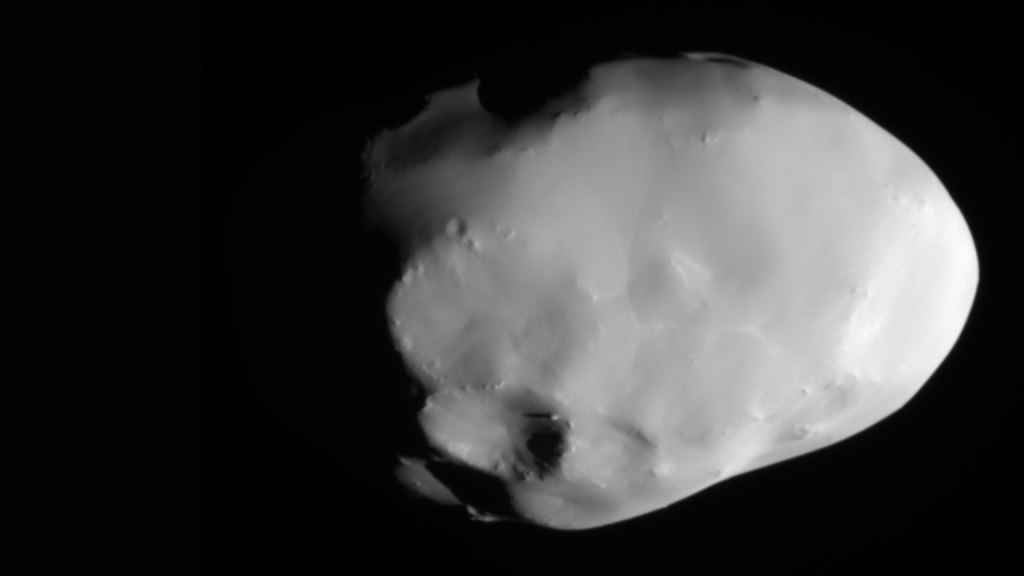
In 1980, Fountain joined astronomers Bradford Smith, Harold Reitsema and Stephen Larson in ground-based observations that resulted in the co-discovery of another Saturnian satellite, Telesto.
Telesto is considerably different from Epimetheus.
It is what astronomers call a Trojan moon, sharing an orbit with the much larger Saturnian moon Tethys. Telesto travels about 60 degrees ahead of Tethys, while another small moon, Calypso, occupies a corresponding position behind it.
NASA’s Cassini spacecraft eventually provided detailed images of Telesto decades after Fountain and his colleagues helped identify it from Earth.
Together, the discoveries meant Fountain was credited as a co-discoverer of two satellites orbiting one of the most recognizable planets in the solar system.
Fountain’s work extended well beyond Saturn’s moons.
During the 1970s, he studied photographs of Venus, Mars and Jupiter, documenting changes in planetary surfaces and atmospheres.
That experience led to his involvement with the imaging teams supporting NASA’s Pioneer 10 and Pioneer 11 missions. Those missions became historic chapters in planetary exploration, with Pioneer 10 becoming the first spacecraft to travel through the asteroid belt and make close observations of Jupiter, while Pioneer 11 later became the first spacecraft to encounter Saturn.
Fountain’s contributions were recognized by NASA. He received a Public Service Achievement Award in 1974 and a Pioneer Saturn Special Citation in 1979.
Later in life, Fountain turned much of his attention toward archaeoastronomy, the study of how ancient civilizations understood and incorporated astronomical events into their cultures.
He investigated petroglyphs and other archaeological sites, studying whether ancient rock art had connections to the movements of the sun and other astronomical phenomena.
Fountain documented rock art that appeared to interact with sunlight during events such as solstices and equinoxes and built a database of what were known as solar markers.
His career had effectively come full circle.
The young scientist who once studied photographs of the moon eventually spent his later years examining how people who lived centuries earlier had studied the same sky.
Fountain died June 7, 2016, at age 72. An obituary published by the American Astronomical Society several years later remembered him as a planetary scientist, archaeoastronomer and co-discoverer of two Saturnian satellites.
Today, Epimetheus continues its remarkable orbital dance with Janus, periodically approaching its neighboring moon before the pair effectively exchange places around Saturn.
Telesto continues circling the planet alongside Tethys.
And attached to the history of both distant worlds is the name of a scientist whose story began in Quincy, Illinois.