
Quincy-Born Man’s Botched 1879 Execution Became Part of U.S. Supreme Court History
More than 145 years ago, a man born in Quincy sat in a chair inside a Utah jail yard, refused a blindfold and waited for a firing squad to shoot him through the heart. What happened next became one of the more disturbing botched executions of the 19th century and forever connected Wallace Wilkerson’s name to a landmark U.S. Supreme Court case involving the meaning of cruel and unusual punishment.
Wilkerson was born in Quincy into a Mormon family before moving west with his family while still young. His life eventually took him to Utah Territory, where he worked as a stockman and horse breaker and at one point served as a military drummer. By the late 1870s, however, his life had taken a dramatically darker turn.
On June 11, 1877, Wilkerson encountered bartender William Baxter at a saloon in Utah’s Tintic Mining District. The men began playing cribbage for money, but the game deteriorated into an argument involving accusations of cheating. The confrontation ended when Baxter was shot in the head and killed.
Wilkerson was arrested the following day. Authorities reportedly kept him under guard amid concerns that he could be lynched before receiving a trial. He maintained his innocence, but a jury convicted him of murder in November 1877.
At the time, Utah Territory allowed condemned prisoners to choose among several methods of execution. Wilkerson was given the choice of hanging, decapitation or death by firing squad. He selected the firing squad.
His attorneys continued fighting the sentence, eventually carrying the case all the way to the U.S. Supreme Court. The resulting case, Wilkerson v. Utah, became one of the Supreme Court’s earliest significant examinations of the Eighth Amendment’s prohibition against cruel and unusual punishment.
Wilkerson’s attorneys argued that execution by firing squad constituted cruel and unusual punishment. The Supreme Court disagreed. In March 1879, the court upheld his sentence and determined that execution by shooting was not, by itself, constitutionally prohibited.
The ruling cleared the way for Wilkerson’s execution on May 16, 1879.
Shortly before his death, Wilkerson was taken to Provo. Historical accounts describe a relatively small number of people being allowed inside the jail yard while a much larger group gathered outside to witness the event as closely as authorities would permit.
Wilkerson reportedly dressed in black and wore a white felt hat. When officials attempted to prepare him for the execution, he refused a blindfold and declined to be restrained.
He reportedly made it clear that he intended to face death directly.
A white target was placed over his heart. The members of the firing squad were positioned roughly 30 feet away and concealed from Wilkerson’s view. His reported instruction to them was straightforward: aim for his heart.
The plan was for the bullets to strike the heart simultaneously and cause an almost immediate death.
That is not what happened.
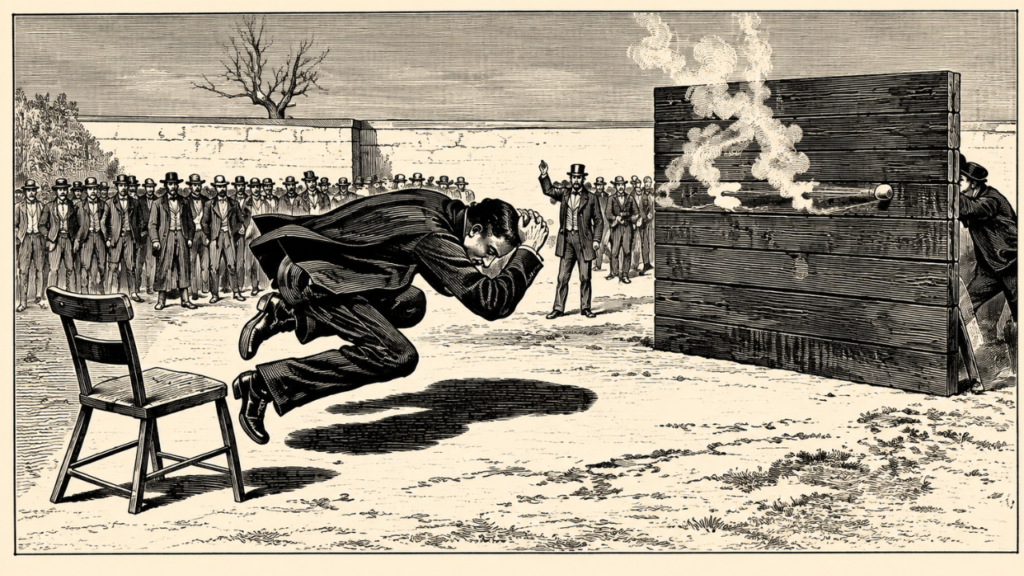
As the execution countdown reached its final moments, Wilkerson apparently stiffened or shifted slightly in the chair. When the firing squad fired, the bullets missed the intended target.
One bullet shattered his arm while other rounds struck his torso. Instead of dying instantly, Wilkerson reportedly lurched or jumped from the chair after being shot.
What had been intended as a rapid execution became a prolonged and gruesome death.
Doctors rushed to him as he struggled on the ground. Historical accounts differ on exactly how long Wilkerson remained alive. Some reports say approximately 15 minutes, while others place the period between the shots and his death at closer to 27 minutes.
He ultimately died from blood loss.
The failure of the execution drew attention because the method had just survived Wilkerson’s own constitutional challenge before the nation’s highest court. Only about two months earlier, the Supreme Court had ruled that execution by firing squad did not inherently constitute cruel and unusual punishment.
His remains were eventually placed in a coffin and returned to his wife for burial in Payson, Utah.
The circumstances surrounding his death ensured that Wilkerson would be remembered for far more than the murder conviction that led him to the execution yard.
Wilkerson v. Utah continued to appear in American constitutional law long after his death. The Supreme Court referenced the decision in later discussions about execution methods and the kinds of punishments prohibited under the Eighth Amendment.
That gives Wilkerson an unusual place in American legal history.
His case arose during an era when the country was still wrestling with fundamental questions about capital punishment, including which methods crossed the constitutional line into cruelty and whether certain forms of execution could be permitted by the government.
For Quincy, the story represents an obscure and surprisingly significant local connection to that national debate.
A man whose life began along the Mississippi River in Quincy eventually moved west, became involved in a frontier murder case and challenged his death sentence before the U.S. Supreme Court.
He lost that challenge.
Then, in a dark historical irony, the very method of execution the Supreme Court had determined was constitutionally permissible failed to produce the quick death authorities intended.
More than a century later, Wallace Wilkerson remains remembered as both a convicted murderer and the Quincy-born defendant whose case helped shape some of the earliest Supreme Court precedent surrounding cruel and unusual punishment.
His final moments also remain a chilling reminder that the history contained in Supreme Court decisions sometimes extends far beyond legal language written on a page.