
The Quincy-Born Inventor Who Dreamed Up the Minivan Decades Before America Was Ready
William Bushnell Stout was born in Quincy in 1880. Long before the Dodge Caravan or Plymouth Voyager became fixtures of American family life, Stout built a radically different automobile that many historians now recognize as an important precursor to the modern minivan.
Most people associate the birth of the minivan with the early 1980s, when Chrysler introduced the Dodge Caravan and Plymouth Voyager and created a new category of family vehicle.
But decades before that happened, a Quincy-born inventor was already imagining the same basic idea: a vehicle with a roomy interior, flexible seating, a rear-mounted engine and a body designed around passengers rather than a long hood and conventional trunk.
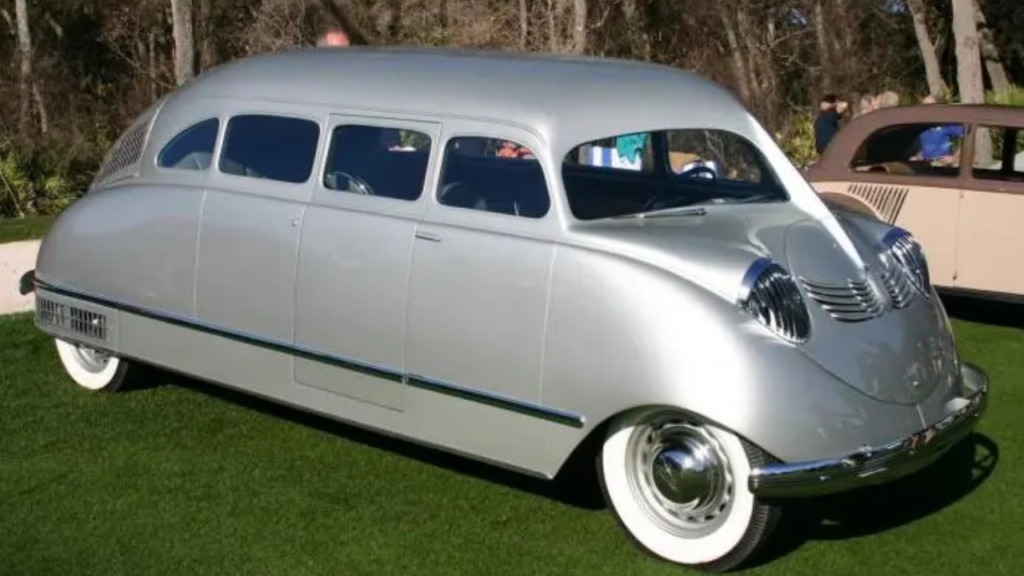
His name was William Bushnell Stout, and his 1930s creation, the Stout Scarab, looked so far ahead of its time that it still resembles an early sketch of the modern minivan.
Stout was born in Quincy on March 16, 1880. He later moved with his family and studied engineering, but his career would become defined by an almost relentless desire to rethink machines people already thought they understood. He worked on automobiles, trucks, airplanes, rail vehicles, prefabricated housing and even flying cars.
He was not simply trying to improve existing designs.
He wanted to start over.
Designing the car from the inside out
By the early 1930s, most automobiles followed a familiar formula: a long engine compartment in front, a passenger compartment in the middle and storage in the rear.
Stout approached the problem differently. He believed a vehicle should be designed around the people inside it.
That thinking led to the Stout Scarab, a rear-engine automobile with a long, rounded body and an unusually spacious passenger compartment. The rear-mounted engine eliminated the need for a large hood, allowing more of the vehicle’s overall length to be devoted to people. The interior was even more unusual.
Instead of permanently fixed seating, the Scarab used flexible arrangements that allowed passengers to face one another and make better use of the cabin. Stout envisioned the interior almost like a small room on wheels rather than a conventional car.
That sounds remarkably familiar today.
Modern minivans emphasize passenger space, flexible seating, family comfort and efficient packaging. Those same priorities were visible in the Scarab roughly half a century before Chrysler brought the minivan into millions of American driveways.
The Smithsonian has since described Stout as being credited with inventing the first minivan, while histories of the minivan routinely identify the Scarab as one of the earliest vehicles to anticipate the format.
A car that looked like it came from the future
The Scarab was unlike almost anything else on American roads.
Its body was smooth and streamlined. The wheels were pushed toward the corners of the car, helping maximize interior space. The engine sat behind the passengers, and the cabin was open enough to allow occupants to move around more freely than in conventional automobiles of the period.
The first prototype appeared in 1932, and Stout formed the Stout Motor Car Company in 1934.
His goal was not to build a cheap mass-market automobile. The Scarab was expensive, highly experimental and produced in extremely small numbers.
That ultimately kept it from becoming the family transportation revolution Stout imagined. But the concepts behind it survived.
Decades later, vehicle designers would embrace the same basic packaging philosophy: maximize passenger room, minimize wasted space and make the interior adaptable to different family needs.
When Chrysler finally launched the Caravan and Voyager in 1983, the company created the modern mass-market minivan as Americans came to know it. The Smithsonian notes that Chrysler’s great breakthrough was combining car-like driving characteristics with the passenger and cargo capacity of a van.
Stout had been exploring that basic concept in the 1930s.
Quincy’s inventor also helped change aviation
The Scarab alone would make Stout noteworthy, but automobiles were only part of his career.
His work in aviation was arguably even more important.
Stout became fascinated with aircraft construction during the early years of aviation and pushed heavily for the use of metal rather than the wood-and-fabric construction common at the time.
He founded the Stout Metal Airplane Company, where he developed all-metal aircraft and experimented with passenger transportation. Ford Motor Co. purchased the company in the 1920s.
Stout’s designs and engineering ideas helped lead to the development of the Ford Trimotor, one of the most famous early commercial airplanes.
The Trimotor became a workhorse of early passenger aviation and helped demonstrate that airplanes could move people and cargo reliably over regular routes.
Stout also founded Stout Air Services, which began scheduled passenger service in the 1920s and was later sold to the company that became United Airlines.
In other words, the Quincy-born engineer was thinking about how Americans would travel both on the road and in the sky.
He rarely accepted that something was “good enough”
One of the most consistent themes of Stout’s career was dissatisfaction with accepted design.
He experimented with aircraft that combined automobiles and airplanes. He proposed unusual rail vehicles. He worked with fiberglass automobile bodies decades before fiberglass became common in production cars. He investigated air suspension, electric doors and lightweight construction.
His later experimental automobile, the Stout Forty-Six, explored ideas including a frameless fiberglass body, air-controlled suspension and electrically operated doors.
Many of those concepts sounded exotic in the 1940s.
Today, lightweight composite materials, powered doors and sophisticated suspension systems are ordinary parts of automobile engineering.
Stout also became associated with the engineering philosophy summarized as “Simplicate and add more lightness,” reflecting his belief that good design often came from eliminating unnecessary weight and complexity rather than simply adding more machinery.
An idea ahead of its market
The Stout Scarab never became a commercial success.
That may have had less to do with the concept than with timing.
American consumers in the 1930s were accustomed to automobiles that looked and behaved in a certain way. The Scarab was expensive, unconventional and visually radical. The market simply was not ready for a vehicle that blurred the lines between automobile, lounge and people carrier.
Half a century later, the basic philosophy suddenly made perfect sense.
Chrysler’s minivans became an enormous success because they offered families exactly what Stout had emphasized decades earlier: efficient passenger space, flexible interiors and practical transportation without the bulk of a full-size van.
The modern minivan did not descend directly from the Scarab in a simple engineering line. Chrysler developed its own platform and production approach.
But the resemblance in concept is hard to miss.
Stout had already asked the essential question:
What if the automobile were designed around the people inside it instead of around the engine?
A Quincy-born inventor who saw the future
William Bushnell Stout died in 1956, long before the word “minivan” became part of American vocabulary. He never saw the suburban parking lots filled with Caravans, Voyagers, Siennas and Odysseys. But many of the ideas he explored had become normal by the end of the 20th century.
Stout spent his career imagining what transportation might become rather than accepting what it already was.
And that career began in Quincy.
More than 140 years after his birth here, William Bushnell Stout can be remembered not simply as an engineer or aircraft designer, but as a Quincy-born inventor whose ideas anticipated one of the most familiar family vehicles in American life.
Long before America was ready for the minivan, Stout had already built something remarkably close to one.