
The Quincy Doctor Who Helped Pioneer Modern Jaw Surgery
Thomas Lewis Gilmer spent 13 years practicing medicine and dentistry in Quincy, earned his medical degree here, worked as an oral surgeon at St. Mary’s Hospital and taught at the Quincy College of Medicine. What happened during those years helped place his name into the history of oral and maxillofacial surgery.
Most people in Quincy today would probably not recognize the name Thomas Lewis Gilmer.
Yet in the late 19th century, Gilmer was quietly building a career here that would eventually influence the treatment of serious facial injuries, help shape dental education in Chicago and leave his name attached to a surgical technique still referenced in medical literature more than a century later.
His connection to Quincy was not incidental. It was formative.
Gilmer practiced dentistry and medicine in Quincy from 1876 until 1889, a period of roughly 13 years. During that time he earned his M.D. from the Quincy College of Medicine, served as an oral surgeon at St. Mary’s Hospital, taught microscopy and histology, and began publishing work on the treatment of fractured jaws. Washington University’s Becker Medical Library preserves a biographical record of Gilmer’s career and specifically identifies Quincy as the place where his medical and surgical work developed before he moved to Chicago. Becker Exhibits
What makes that particularly significant is that some of the work for which Gilmer later became known dates directly to those Quincy years.
A dentist who became a surgeon
Gilmer was born in Lincoln County, Missouri, in 1849 into a family with a long medical tradition.
He studied dentistry before settling in Quincy in 1876 and continued his formal education while practicing.
Washington University’s archival biography records that Gilmer received his dental degree from the Missouri Dental College in 1882 and his medical degree from the Quincy College of Medicine in 1885. After obtaining the M.D., he served as oral surgeon at St. Mary’s Hospital and taught microscopy and histology at the Quincy medical school.
A contemporary professional biography gives an even more detailed chronology. It lists Gilmer as practicing dentistry in Quincy from 1876 to 1881 and again from 1882 to 1889, teaching microscopy and histology at the Quincy College of Medicine from 1885 to 1889, and serving as oral surgeon at St. Mary’s Hospital during those same years. HSLS Exhibits
That combination was unusual for the era.
Gilmer was not simply filling cavities or extracting teeth.
He was operating at the developing intersection of dentistry, medicine and surgery, the field that would eventually become modern oral and maxillofacial surgery.
His important jaw-fracture work began while he was in Quincy
One of the most revealing pieces of Gilmer’s professional record dates to 1881, only a few years after he arrived in Quincy.
That year he presented a lengthy paper titled “Fractures of the Inferior Maxilla” before the Illinois State Dental Society.
“Inferior maxilla” was the terminology then commonly used for the lower jaw, or mandible.
The original 1881 proceedings survive and describe various methods of stabilizing serious mandibular fractures, including splints and wiring techniques. Wikimedia ommons
Later historical scholarship noted that Gilmer was then practicing in Quincy and was being mentored by another major figure in American dentistry, Greene Vardiman Black.
A historical article published by the American College of Dentists describes Gilmer as a Quincy practitioner and explains that Black encouraged him to present the 1881 fracture paper. Black even prepared dozens of illustrations to accompany it.
That places Quincy directly in the early development of Gilmer’s work on jaw trauma.
It was not something he began only after becoming a Chicago academic.
He was already studying complicated mandibular fractures while practicing here.
The technique that became “Gilmer wiring”
The more consequential breakthrough came in 1887.
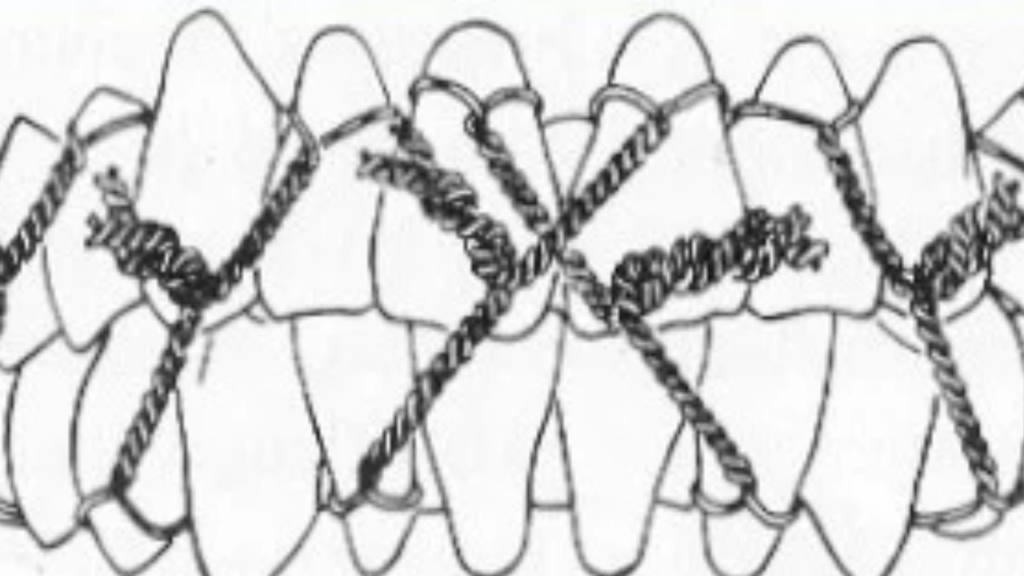
Gilmer described a method of treating a fractured jaw by using wires around the teeth of the upper and lower jaws and securing them together so the broken mandible would remain immobilized in proper alignment.
The concept became known as Gilmer wiring, or the Gilmer method of intermaxillary fixation.
Modern medical dictionaries still carry the term.
Taber’s Medical Dictionary defines Gilmer wiring as a method in which opposing teeth are wired together to achieve intermaxillary fixation — essentially stabilizing the lower jaw against the upper jaw so a fracture can heal in the correct position. F.A. Davis PT Collection
More importantly, later surgical literature credits Gilmer with helping establish the principle.
A 20th-century article in what is now JAMA Otolaryngology–Head & Neck Surgery stated that immobilization of jaw fractures in correct dental alignment by intermaxillary wiring was first advocated by Gilmer in 1887, and noted that later closed-reduction techniques were built on the same basic concept. JAMA Network
Modern maxillofacial literature likewise identifies direct interdental wiring — Gilmer, 1887 as one of the foundational methods of intermaxillary fixation. PubMed Central (PMC)
And that date matters locally.
In 1887, Gilmer was still living, practicing and teaching in Quincy.
His work continued to influence medicine
Gilmer continued publishing well after leaving Quincy.
In 1904, he published a case involving multiple fractures of the lower jaw complicated by fractures of the upper jaw in the International Dental Journal. That paper remains indexed today by the National Library of Medicine.
He also published on tumors and abnormal dental growths known as odontomes.
And in 1916, he published an extensive paper titled “Chronic Oral Infections and Their Relation to Diseases in Other Parts.”
That article examined the idea that infection originating in the mouth could influence disease elsewhere in the body — an issue that remains part of modern discussions about oral health and systemic disease. The original paper survives through the National Library of Medicine’s digital archive.
His career therefore stretched well beyond fracture treatment.
He was part of a generation attempting to transform dentistry from a largely mechanical trade into a medically grounded scientific profession.
For a city whose medical history is often told through its hospitals and institutions, Thomas Lewis Gilmer represents something different:
a Quincy physician whose work became part of the vocabulary of surgery itself.