
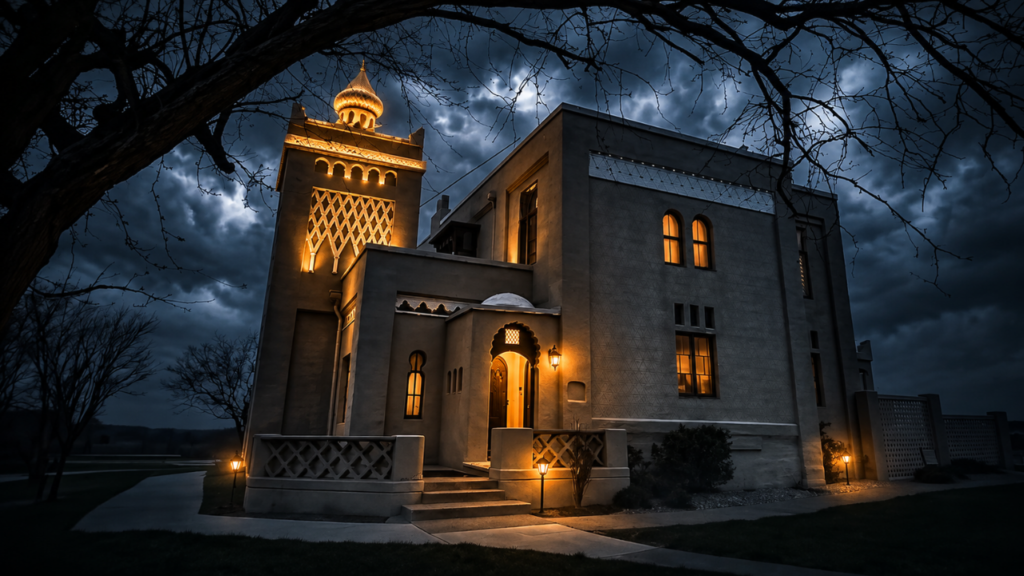
Has Quincy Become a Beacon for Muslims? The City’s Islamic-Inspired Welcome Center Raises Questions
In a town where the mere mention of Islam can inspire a spirited debate, it seems the city has spent decades inviting the world to visit a building with architectural element inspired by a mosque.
QUINCY, Ill. — There is an old and respectable custom among Americans of becoming thoroughly alarmed about something that has been sitting peacefully in their backyard for a hundred years.
Quincy, Illinois, being an American city of considerable distinction and no shortage of opinions, appears determined not to neglect this tradition.
For some time now, the subject of Islam has stirred spirited discussion among local residents. Some regard its growing visibility in America with concern. Others insist that religious liberty ought to mean precisely what the Constitution says it means. Both sides have demonstrated a remarkable ability to make themselves heard.
But while the good citizens of Quincy have been occupied debating whether Islamic influences belong in their community, an extraordinary discovery has emerged.
The city has been operating its tourist information center inside a building adorned with Islamic-inspired architecture.
And not just recently, either.
The building has stood there since 1900.
The building in question is Villa Kathrine, that magnificent and peculiar residence perched above the Mississippi River, which has long enjoyed the affectionate admiration of Quincy’s residents.
Its architecture was inspired by the travels of W. George Metz, a Quincy gentleman who visited North Africa, encountered the beauty of Moorish buildings and returned home with the perfectly reasonable conviction that what the Mississippi River bluffs required was something resembling a Moroccan villa.
Most men returning from abroad are satisfied with a souvenir.
Metz brought home an architectural philosophy.
The resulting residence featured elegant arches, an interior courtyard and a tower inspired by a mosque’s minaret. The minaret, for those unfamiliar with such matters, is traditionally associated with Islamic houses of worship.
And here is where our little tale becomes particularly delicious.
At some point in the city’s history, those responsible for encouraging tourism surveyed the available real estate and concluded that the ideal place to welcome visitors to Quincy was this very building.
One imagines the conversation was brief.
“Where shall we put the visitor center?”
“How about the place with the mosque tower?”
“Excellent. Order some brochures.”
And thus, through the quiet machinery of municipal decision-making, Quincy established what a mischievous observer might call the most unlikely Islamic-inspired welcome center in the Midwest.
Now, before the reader becomes unnecessarily excited, Villa Kathrine is not a mosque, has never been established as one and offers no religious services. It is a historical landmark and tourist attraction. The distinction is important, although it does threaten to spoil an otherwise magnificent rumor.
Still, one must consider the possibilities.
Could it be that travelers of the Muslim faith, upon discovering a photograph of this handsome building with its familiar architectural flourishes, have begun to regard Quincy as a destination of uncommon interest?
Could a visitor in Morocco, Tunisia or elsewhere gaze upon the Villa’s distinctive tower and conclude that somewhere in the cornfields of western Illinois there resides a community possessing a particularly enthusiastic appreciation of Islamic architecture?
Might Quincy, without so much as passing a resolution, have become an accidental beacon to Muslims?
There is no evidence establishing any such phenomenon, of course. But evidence has rarely prevented a good Quincy argument from reaching its full potential.
The situation is made even more entertaining by the geography.
Here, on the banks of the Mississippi, not terribly far from the childhood home of Mark Twain, stands a monument to the architectural imagination of North Africa. One can almost hear Twain chuckling at the spectacle of a community discussing the dangers of foreign influence while handing out tourism brochures beneath a tower inspired by a foreign mosque.
It is the sort of contradiction that makes the human race endlessly interesting and occasionally exhausting.
And consider the unsuspecting visitor.
A traveler arrives in Quincy, perhaps drawn by a photograph of Villa Kathrine, and approaches its entrance with great anticipation. There, beneath the graceful influence of Moroccan architecture, the visitor discovers that the grand cultural experience awaiting them consists of maps, restaurant recommendations and information about area attractions.
Yet perhaps the remarkable thing is not that Quincy possesses Islamic-inspired architecture, but that it has celebrated that architecture for generations without requiring anyone to settle a religious argument first.
Schoolchildren have visited Villa Kathrine. Families have photographed it. Tourists have admired it. Local officials have promoted it. The community has devoted time, money and considerable enthusiasm to preserving it.
And through all these years, the minaret has stood quietly above the Mississippi, apparently unaware that it might someday be called upon to testify in a cultural controversy.
It has made no speeches, issued no proclamations and argued with nobody.
In this respect, it has demonstrated a level of civic restraint from which the rest of us might profit.
The building’s original owner, George Metz, would surely find the modern debate entertaining. A traveler of considerable curiosity, Metz evidently understood that civilization contains beautiful things beyond one’s own county line.
He did not require his neighbors to adopt the religious traditions of North Africa before permitting himself to admire their craftsmanship.
He simply built a house. A most extraordinary house, certainly, but a house nonetheless.
And more than a century later, Quincy continues to preserve his creation, promote its beauty and invite strangers through its doors.
Perhaps this makes Quincy a beacon of architectural appreciation. Perhaps it makes us a community with a peculiar sense of historical preservation. Or perhaps it merely proves that tourism officials know a memorable building when they see one.
As for the question of whether Muslims are being drawn to Quincy by the presence of its Islamic-inspired visitor center, the evidence remains as elusive as a parking space on Maine Street during a popular downtown event.
So, should Quincy find itself becoming an international destination for admirers of Islamic architecture, its citizens may take comfort in knowing that the groundwork was laid by a wealthy local gentleman more than a century ago.
He asked no permission of the future.
He organized no committee.
He simply built a Moroccan-inspired villa on the Mississippi River and left subsequent generations to explain themselves.
And the city put its tourist welcome center inside it.
—
Villa Kathrine’s official history dates its construction to 1900-1901 and identifies architectural influences from Morocco, Tunisia and Spain. The Quincy Park District confirms that the building houses the tourist information center.
This article is satire and do not allege actual religious recruitment or a documented increase in Muslim tourism.