


Quincy Police Chief Defends Flock Cameras as Local Debate Intensifies
Interim Police Chief Mike Tyler told the Quincy City Council that the cameras remain an important investigative tool, while residents continued to raise questions about privacy, data sharing and oversight.
QUINCY, Ill. Quincy Interim Police Chief Mike Tyler defended the Quincy Police Department’s continued use of Flock automated license plate reader cameras Tuesday night, addressing a controversy that has increasingly divided residents locally while drawing growing scrutiny across the country.
Tyler provided an update on the technology during Tuesday’s Quincy City Council meeting at the request of Ward 1 Alderman Eric Entrup. He described the cameras as an investigative tool that captures images of vehicles traveling on public roadways and pushed back against some of the claims circulating about what information the system collects.
The presentation comes as Flock cameras have become one of the more vigorously debated public-safety issues in Quincy in recent weeks.
Tyler specifically challenged assertions that the cameras continuously track individual people or contain extensive personal information about motorists.
“When people are saying they’re being tracked and they know all this information, [the cameras don’t] have any information,” Tyler said.
Tyler maintained that Quincy police are using the technology responsibly and said misconceptions circulating on social media have contributed to the controversy surrounding the system.
Flock cameras photograph vehicles and license plates as they pass fixed locations. Police can subsequently search stored information during investigations or receive alerts associated with vehicles entered into law enforcement databases.
The distinction between photographing vehicles at individual locations and creating a searchable record of where vehicles have been observed has become central to the national debate surrounding automated license plate readers.
Questions About Data Sharing
During public comment following the update, residents expressed views on both sides of the issue, reflecting a debate that has increasingly centered on the balance between investigative value and personal privacy.
Supporters have pointed to the cameras’ ability to help police locate stolen vehicles, identify vehicles associated with crimes and assist in searches for wanted or endangered individuals.
Opponents have questioned how long information should be retained, which agencies should have access to it, whether searches can be sufficiently audited and whether a network of cameras capable of documenting vehicle movements creates a level of surveillance residents are comfortable accepting.
Those questions are not unique to Quincy.
Quincy Current Poll Shows Strong Opposition Among Respondents 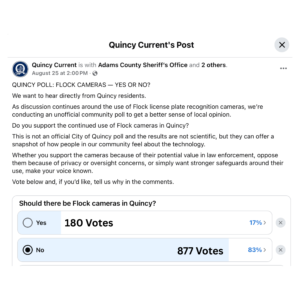
Quincy Current has also been measuring reader sentiment toward the cameras during the past several weeks.
More than 1,000 votes were cast in an unofficial Quincy Current poll asking residents about continued use of Flock cameras.
The polling system was configured to accept one vote per IP address and restricted participation geographically to an area surrounding Quincy. Among those who chose to participate, respondents overwhelmingly opposed continued use of the cameras.
The result should not be interpreted as a scientific public-opinion survey or as establishing the views of Quincy residents as a whole.
Participants were self-selected rather than randomly sampled, and controls such as IP restrictions and geographic limits can reduce duplicate or out-of-area responses but do not create a statistically representative sample.
What the poll does demonstrate is that a substantial number of Quincy Current readers who participated have strong concerns about continued use of the technology.
That public skepticism exists alongside the Quincy Police Department’s continued support for the system. 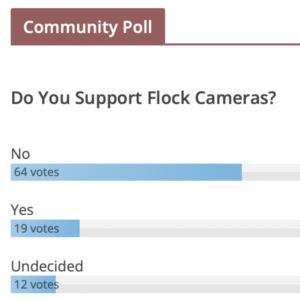
Nearby Sheriff Suspended His Cameras
The local debate has also intensified as other law enforcement agencies reconsider their participation in Flock’s network.
Just across the Mississippi River, Ralls County Sheriff Brian Allen suspended his department’s use of Flock cameras on Sept. 1, saying he wanted additional answers concerning what information is retained, who can access it and whether information collected through the cameras is sold.
Allen ordered the county’s stationary camera on U.S. 61 near Spencer Creek covered and parked a mobile traffic trailer containing another camera at the sheriff’s office while awaiting additional information from Flock.
Other jurisdictions in Illinois and elsewhere have recently suspended, restricted or reconsidered use of Flock technology amid allegations of improper database searches and broader privacy concerns. Homer Glen, Illinois, for example, suspended Flock use pending review after allegations involving misuse by a law enforcement officer.
The national scrutiny has grown considerably. Recent reporting has documented instances in which law enforcement personnel were accused of accessing automated license plate reader systems for unauthorized personal purposes, while state and local governments have begun considering additional restrictions.
Those incidents do not establish that Quincy police have improperly used the system.
Quincy Current has not identified evidence that a Quincy officer has used Flock cameras for an unauthorized personal purpose.
The national cases are relevant because they illustrate the concerns residents are raising about what safeguards exist when a database capable of searching vehicle movements is made available to authorized users.
Public Safety and Privacy Remain at Center of Debate
The discussion in Quincy has increasingly moved beyond whether the cameras can assist police.
They clearly can.
The larger question is what safeguards should accompany that capability.
Residents have asked who can search Quincy’s Flock data, what justification must be provided for a search, which outside agencies are permitted access, how long records are retained and what auditing occurs to identify inappropriate use.
Police, meanwhile, argue that eliminating the cameras would remove a valuable investigative resource that can help officers develop evidence much more quickly than traditional investigative techniques alone.
Both arguments were evident Tuesday night.
For Tyler, the answer remains continued use with safeguards.
For many residents participating in Quincy Current’s poll and speaking publicly, the assurances have not yet resolved their concerns.
As other communities reconsider automated license plate readers and national scrutiny of Flock continues, Quincy now finds itself confronting the same fundamental question being debated across the country.
How much surveillance is an acceptable tradeoff for another tool in the fight against crime?
For now, the Quincy Police Department intends to keep its cameras operating.