
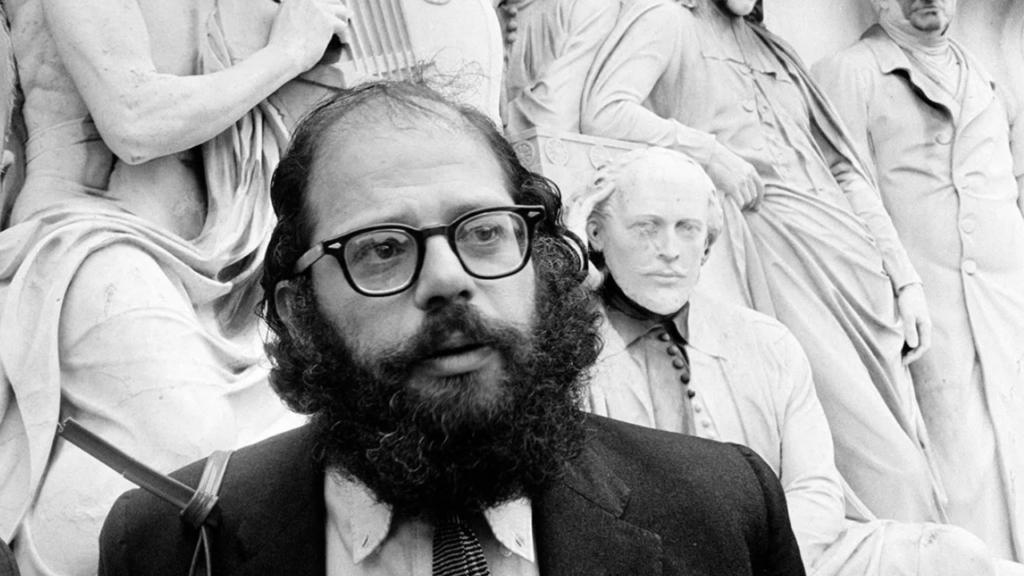
The Night Allen Ginsberg Came to Quincy — and the FBI Was Watching
In 1970, one of America’s most controversial poets walked into Quincy College wearing blue jeans and a corduroy jacket. The FBI knew he was coming. What students heard that night went well beyond poetry.
On the evening of March 18, 1970, Allen Ginsberg came to Quincy.
He was already one of the most recognizable figures of the Beat Generation, the author of Howl, a countercultural celebrity, political activist and poet whose work had helped redefine postwar American literature.
He also arrived with the attention of the Federal Bureau of Investigation.
An FBI memorandum (seen below) contained in Ginsberg’s government file shows that the Bureau’s Springfield office knew in advance that he would appear at Quincy College, now Quincy University. The memo identified him as the “Hippie Poet” and reported that he was scheduled to read poetry at 8 p.m. in the college’s Social Hall. The appearance, according to the FBI, was sponsored by the Quincy College Cultural Affairs Committee, described specifically as “a faculty organization.”
The FBI nevertheless decided not to send agents to monitor the event.
“Since this appearance does not seem to have any connection with New Left activities,” the memo stated, the Springfield office would provide no coverage and was forwarding the information only for Bureau purposes. Ginsberg
More than half a century later, that single government document opens a remarkable window into a forgotten night in Quincy history.
But the story becomes considerably more complicated when viewed through everything that came afterward.
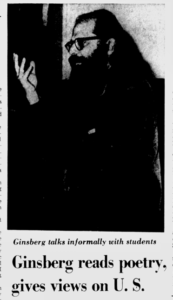
A counterculture icon comes to a Catholic college
By 1970, Ginsberg was hardly an obscure visiting poet.
His 1956 poem Howl had helped make him one of the central literary figures of the Beat movement. He moved in the same cultural universe as Jack Kerouac, William S. Burroughs and other writers who challenged conventional American attitudes toward sexuality, religion, politics, drugs and artistic expression.
His FBI file shows federal authorities had followed his activities for years, including his travels abroad and political associations. The Quincy memorandum was therefore not an isolated curiosity. It was one small entry in a much larger government file.
What makes the Quincy appearance noteworthy is that he had been invited by a faculty organization at a Catholic college in a comparatively conservative Midwestern community.
And according to accounts of the appearance, students did not hear only poetry.
Ginsberg also discussed altered consciousness and psychedelic drugs.
One statement attributed to him during the Quincy appearance described what he viewed as different paths toward an elevated state of consciousness:
“Some form of majestic consciousness can be obtained either through your own silence, or through divine grace, or through yogic experiment or American experiment with peyote or acid.”
He also reportedly warned students about illicit LSD circulating in the United States, saying it was unsafe because black-market supplies could be adulterated, including with barbiturates.
Ginsberg was not simply telling students to indiscriminately take LSD. His broader public record shows that his views on psychedelics were complicated: he regarded them as tools capable of altering consciousness while also discussing their dangers and criticizing the culture surrounding illicit drugs. In a 1966 interview, for example, he described his own severe anxiety while using LSD and said he had at one point stopped taking it.
Still, the idea of a nationally known counterculture figure addressing students at Quincy College about peyote, LSD and expanded consciousness would have been striking in 1970.
It remains striking today.
What did Ginsberg look like in Quincy?
The scene itself must have seemed almost cinematic.
Accounts describe Ginsberg arriving in a corduroy jacket, blue jeans, sneakers, dark shirt and flowered tie, with a beaded necklace completing the unmistakably countercultural appearance.
There was little about him that would have resembled a conventional visiting academic lecturer. He was part poet, part activist, part spiritual seeker and part cultural provocateur.
His public philosophy blended poetry, Eastern religion, antiwar politics, meditation, sexuality and psychedelic experimentation. He would later formalize his commitment to Buddhism, but by 1970 those influences were already deeply embedded in his worldview.
The FBI apparently knew exactly what kind of figure Quincy College was bringing to campus.
The memo was routed from the Springfield office to FBI headquarters and identified the event, its sponsor, location and time. Yet the Bureau concluded that there was no apparent “New Left” connection and therefore declined to provide coverage.
It is easy to read that today as a curious example of Cold War-era surveillance. At the time, however, Ginsberg occupied an unusual place at the intersection of literature and politics.
He had been involved in antiwar activism, countercultural movements and demonstrations. His writings and public statements routinely challenged traditional political, sexual and social norms.
The FBI file therefore reflects a period when poets, professors, activists and musicians could attract the attention of federal internal-security investigators simply because their cultural influence overlapped with political dissent.
That the Bureau ultimately chose not to monitor the Quincy reading is almost as revealing as the fact that someone alerted it in the first place.
A far more troubling controversy came later
Any modern examination of Ginsberg’s legacy must also address a controversy that developed after his Quincy College visit.
Ginsberg later became a member and public defender of the North American Man/Boy Love Association, or NAMBLA.
It became one of the darkest and most enduring controversies attached to his name.
The Poetry Foundation’s biography of Ginsberg notes that he joined NAMBLA and that his involvement generated criticism when Stanford University acquired his papers. Ginsberg maintained that his membership was connected to his defense of free speech.
NAMBLA advocated positions involving sexual relationships between adult men and boys and sought changes to age-of-consent laws. Ginsberg’s public association with the organization has consequently remained deeply controversial, regardless of the free-speech rationale he offered. A recent reassessment of his legacy describes that association as one of the issues complicating modern evaluations of his literary importance.
That later history changes the way a modern reader inevitably looks back at the Quincy event.
A forgotten night in Quincy
For students filing into Quincy College’s Social Hall on March 18, 1970, none of them could have known exactly how Ginsberg’s reputation would evolve over the next quarter-century.
They saw instead one of America’s most famous poets, a bearded counterculture celebrity in blue jeans, sneakers, beads and a corduroy jacket.
He talked about poetry. He talked about consciousness. He talked about meditation and psychedelic drugs.
And somewhere within the federal government, a file had already been opened documenting that Allen Ginsberg was in Quincy.
The FBI decided that night did not require an agent in the audience.
More than 56 years later, its paperwork may be the clearest surviving reminder that the night happened at all.
And perhaps that is what makes the episode so fascinating.
For one evening in 1970, the cultural upheaval reshaping America did not remain in San Francisco, Greenwich Village or on television screens.
It walked through the doors of Quincy College.