
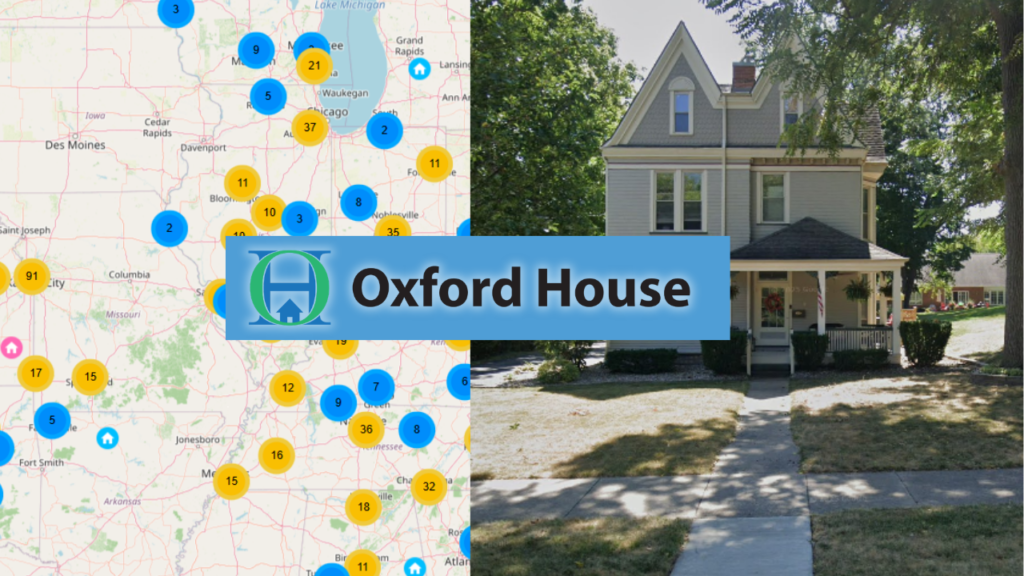
Oxford Houses Expand in Quincy, Renewing Questions About Recovery Housing and Neighborhood Rights
A second Oxford House is now listed in Quincy months after a Maine Street recovery home sparked neighborhood opposition and a debate over how federal fair housing protections intersect with local zoning.
QUINCY, Ill. The arrival of another Oxford House in Quincy is renewing a discussion that first surfaced publicly this spring when neighbors learned that a recovery residence had begun operating in a single-family neighborhood along Maine Street.
The issue places two legitimate interests alongside one another. People recovering from substance use disorders need stable places to live while rebuilding their lives, and federal law provides substantial housing protections to qualifying individuals with disabilities. At the same time, homeowners who own property in established residential neighborhoods have raised questions about occupancy, parking, notification, oversight and what authority local government retains when a recovery house moves nearby.
The legal answer is more complicated than either side of the debate is sometimes made to sound.
Oxford House describes its homes as “self-run, self-supported homes for individuals in recovery from a Substance Use Disorder.” Unlike a traditional treatment facility or staffed halfway house, an Oxford House does not have a house manager or outside authority supervising residents. Members collectively operate the home, share its expenses and govern themselves democratically. Residents must remain drug- and alcohol-free, pay their share of expenses and avoid disruptive behavior in order to remain in the house.
That structure is an important distinction in understanding both the program and the controversy surrounding it.
From Maine Street to South 18th
The issue first drew considerable attention in Quincy earlier this year at 2700 Maine Street, where an Oxford House began operating in a property zoned for single-family residential use.
The City of Quincy initially notified those associated with the property that its use did not comply with the city’s zoning requirements and set a deadline to pursue a special-use permit. Nearby residents publicly raised concerns about the location and the fact that they had received no advance notice that the house would be used as a recovery residence.
That position subsequently changed.
In late May, Quincy officials said the owners had requested an accommodation under federal disability and fair housing laws. The city concluded that the recovery residence was protected under the Fair Housing Act and would not be required to obtain the special-use permit the city had initially sought.
Now Oxford House’s own vacancy system shows another Quincy residence identified as South 18th. As of Aug. 31, the organization listed it as an eight-bed home for men. The same directory also lists another Quincy home called Anchor Point, identified as a 10-bed residence for women.
The appearance of another Oxford House has brought some of the same questions back to the surface.
For nearby residents, those questions can be practical rather than philosophical. How many people can occupy a house designed as a single-family residence? What parking will be available? What happens if an actual nuisance develops? Who is responsible for the property? Why is there no public hearing or neighborhood notification before the use begins?
Those are reasonable questions to ask.
They are not, however, the same as assuming that someone poses a danger merely because he or she is recovering from addiction.
There has been no information reviewed by Quincy Current establishing misconduct by residents of the South 18th Oxford House, and the existence of a recovery residence should not itself be treated as evidence of criminal activity, danger or declining property conditions.
Why federal law changes the zoning discussion
The protections involved stem primarily from the federal Fair Housing Act.
Federal guidance from the Department of Justice and Department of Housing and Urban Development says disabilities covered by the law can include alcoholism and drug addiction when the legal definition of disability is satisfied. Those protections can require municipalities to make reasonable accommodations to zoning rules when necessary to give people with disabilities an equal opportunity to use housing.
There is an important limitation.
Federal protection does not extend on that basis to someone currently engaging in the illegal use of controlled substances. The law also does not prevent action based on an individualized determination that someone presents a direct threat to people or property. Such decisions cannot simply be based on assumptions about addiction or disability.
The case most closely associated with Oxford House and residential zoning reached the United States Supreme Court more than three decades ago.
In City of Edmonds v. Oxford House, Inc., the City of Edmonds, Washington, attempted to apply a zoning definition limiting the number of unrelated people who could constitute a “family” in a single-family district. Oxford House operated a home for 10 to 12 adults recovering from alcohol and drug addiction.
In 1995, the Supreme Court ruled that the city’s family-composition provision was not the type of neutral maximum-occupancy rule automatically exempted from Fair Housing Act scrutiny.
That ruling is sometimes summarized too broadly.
The Supreme Court did not declare that cities have no regulatory authority over Oxford Houses or other recovery residences. Instead, it established an important distinction between rules governing who may live together and legitimate restrictions governing how many people a dwelling can safely accommodate.
DOJ and HUD guidance continues to recognize that cities can enforce nondiscriminatory zoning, building, health and safety requirements. Municipalities may also evaluate requests for reasonable accommodations individually. An accommodation is not automatically required if it would impose an undue burden or fundamentally alter a city’s land-use scheme.
In other words, federal law substantially limits a city’s ability to exclude a recovery home merely because unrelated people with qualifying disabilities live together.
It does not place the property beyond all municipal regulation.
What an Oxford House actually is
That distinction is also important because Oxford House is not structured like many facilities residents might picture when they hear terms such as “rehab,” “halfway house” or “treatment center.”
According to Oxford House, there is no paid house manager or outside authority running an individual residence. The people living there manage it themselves.
Residents elect house officers, divide expenses and make decisions collectively. Each resident pays an equal share toward rent, utilities and household necessities. There is no predetermined limit on how long someone can live in an Oxford House as long as the resident remains in good standing.
The organization’s central rule is sobriety. Oxford House states that a resident who returns to alcohol or drug use must leave the house.
Supporters of the model argue that this structure provides something particularly valuable during recovery. It gives residents stable housing among other people working toward sobriety while requiring them to take responsibility for the operation and cost of their own household.
That is also why describing Oxford House simply as a commercial halfway house can be misleading.
Neighborhood concerns do not disappear
Federal protection does not mean homeowners are prohibited from asking questions.
When the Maine Street controversy developed this spring, some of the frustration centered not solely on recovery housing, but on the way neighbors discovered the house was operating.
Residents told local media they believed there should have been greater communication before a property in their neighborhood began housing a substantially larger group of unrelated adults. Some emphasized that they supported recovery and second chances while questioning how the location was introduced into the neighborhood.
That tension is not unique to Quincy.
Oxford Houses have become the subject of similar discussions elsewhere in Illinois.
In Effingham, residents both supporting and opposing Oxford Houses appeared before the City Council earlier this year. Subsequent proceedings there have focused on questions including parking, bedroom space, occupancy and other property-related requirements. Effingham officials have simultaneously acknowledged that whatever regulations the city adopts must comply with federal fair housing law.
Oxford Houses are established elsewhere in Illinois
Quincy’s experience is relatively new, but the Oxford House model is not.
The organization says more than 3,500 Oxford Houses operate nationwide.
Central Illinois already contains a significant concentration of them. A recent Illinois recovery-resource directory identifies approximately 10 Oxford Houses in the Springfield and immediate Leland Grove area, while Oxford House’s live vacancy system currently shows multiple Springfield residences accepting applicants. Because individual houses and vacancies change, exact counts can fluctuate.
The growth of the model demonstrates why the questions Quincy is confronting are unlikely to disappear.
What recourse do neighbors have?
Perhaps the most important misconception surrounding the issue is that federal protection leaves neighbors or municipalities with “no recourse.”
That is not quite accurate.
Residents of an Oxford House receive fair housing protections applicable to qualifying individuals with disabilities, but a property does not become exempt from every generally applicable law simply because it operates under the Oxford House model.
If a legitimate nuisance occurs, it can be reported.
If parking violates an otherwise lawful ordinance, that can be addressed.
If a building presents a genuine health or safety violation under a rule applied equally to comparable residences, the city retains enforcement authority, subject to federal accommodation requirements where applicable.
What government generally cannot do is prohibit the house simply because its occupants are people recovering from substance use disorders or because neighbors are uncomfortable with that population.
With at least two Oxford Houses now appearing in the organization’s Quincy listings, that discussion is no longer theoretical.
It is taking place in Quincy’s neighborhoods.
The challenge for the city will be ensuring that the conversation remains grounded in what the law actually permits, what the houses actually are and what is actually happening at individual properties, rather than assumptions about the people attempting to rebuild their lives there.
For additional information about the Oxford House model, residents can visit the organization’s official website. Oxford House