Two Websites, Two Very Different Views of Adams County’s Proposed 1% School Sales Tax
New Quincy Resident-Run Website Challenges School Sales Tax Campaign, Raises Questions Ahead of Nov. 3 Vote
A newly launched website is giving Adams County voters a sharply different view of the proposed 1% school facilities and resources sales tax, focusing on spending, accountability, the long-term cost of the tax and several claims being made by supporters of the referendum.
QUINCY, Ill. A Quincy resident has launched a new website challenging the case being made for the 1% school sales tax that will appear on the Nov. 3 ballot, adding another voice to a debate that has generated a growing number of questions from Quincy Current readers.
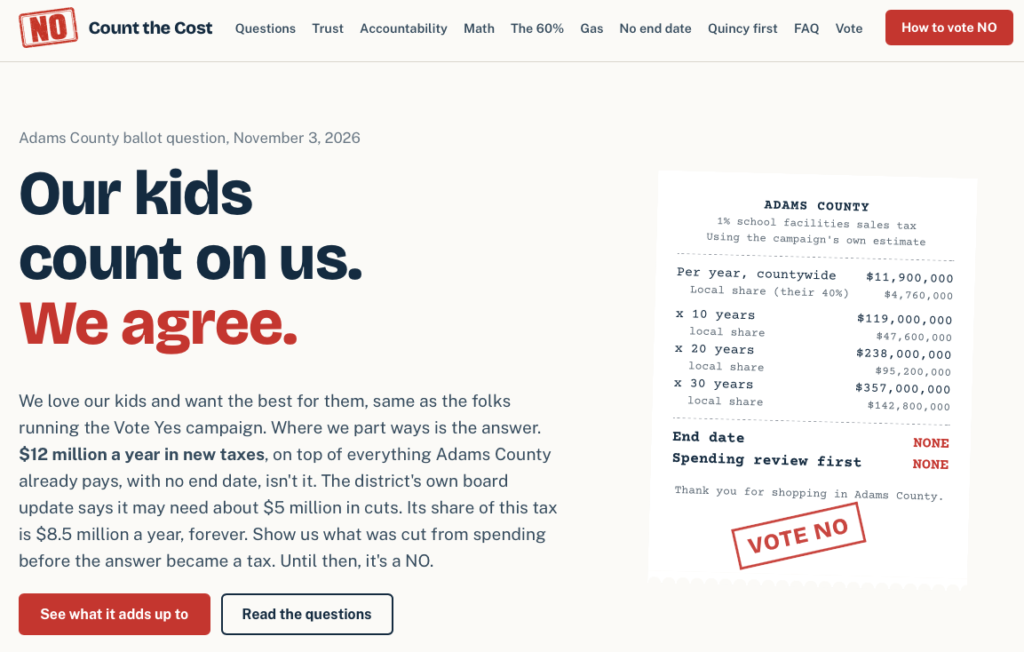
The website, CountTheCostAdams.org, is openly opposed to the referendum and presents itself as an effort by an Adams County resident and taxpayer who support local schools but believe voters should receive more information before approving a new countywide tax.
Its arrival creates a direct counterpoint to AdamsCountyKids.org, the pro-referendum campaign website urging voters to approve the measure.
One distinction is important. AdamsCountyKids.org is closely connected to the school funding discussion that grew from Quincy Public Schools’ Quincy Together process, but the website describes itself as a “volunteer-driven campaign” rather than the official website of Quincy Public Schools. QPS separately operates its own referendum information pages on QPS.org. Adams County Kids
The two sites could hardly frame the same ballot question more differently.
A website built around questions
Count the Cost opens by acknowledging a point of agreement with referendum supporters: local children deserve strong schools.
The disagreement begins with how to pay for them.
The site asks voters to consider whether school districts have sufficiently examined spending before seeking another source of tax revenue. One of its central challenges to the district is: “Show us what was cut from spending before the answer became a tax.” Count the Cost
From there, the site devotes sections to district spending, the estimated annual revenue from the tax, property taxes, gasoline purchases, the source of the widely repeated estimate that 60% of the sales tax would be paid by people from outside Adams County, and the lack of an automatic expiration date.
It also provides sample Freedom of Information Act requests residents can use to seek records from QPS and Adams County government.
That emphasis on questions is likely to resonate with some of the concerns Quincy Current has heard from readers in recent weeks. Residents have asked what happens to existing property taxes if the sales tax passes, how the additional revenue would be used, how the visitor-spending estimate was calculated and whether school spending was examined before the referendum was placed before voters.
Count the Cost takes a clear position against the measure. Its message near the end of the site is concise: “Fix what you control first, then ask.” Count the Cost
The pro-referendum site emphasizes children and school needs
AdamsCountyKids.org approaches the issue from almost the opposite direction.
Its central message is “Our Kids Count on Us,” and the site describes the proposal as an investment in facilities, school safety, mental health services and educational opportunities. Adams County Kids
The campaign says the tax would generate approximately $11.9 million annually across Adams County school districts, with about $8.5 million going to Quincy School District 172. Revenue would be distributed among eligible districts based on enrollment. Adams County Kids
The campaign emphasizes that unprepared groceries, medicine, vehicles, farm equipment and certain other purchases would not be subject to the additional tax. It also gives examples of what the tax would add to individual purchases, including 18 cents on an $18 fast-food meal and 64 cents on a $64 tank of gasoline. Adams County Kids
Its argument is largely built around what additional revenue could make possible.
The campaign highlights building repairs, career and technical education space, school resource officers and mental health professionals. It also argues that improving the district’s overall financial position would help schools retain employees and maintain educational opportunities. Adams County Kids
That last point is one of the areas Count the Cost challenges.
What can the tax actually pay for?
Illinois law restricts how revenue from the County School Facility and Resources Occupation Tax can be spent.
The statute allows revenue to be used for school facility purposes, school resource officers and mental health professionals, depending on the language approved by voters. The Adams County ballot question includes all three categories. Illinois General Assembly
The Adams County Kids website itself acknowledges that the revenue cannot be used for general salaries, supplies or ordinary operating expenses. Adams County Kids
Count the Cost points to that restriction when questioning campaign language about retaining teachers.
The distinction is that the sales tax cannot directly be used to pay general teacher salaries. Supporters can argue that using sales tax revenue for eligible facilities and other authorized expenses could free existing district revenue for other priorities. That is different, however, from the sales tax itself directly funding teacher salaries.
QPS describes the sales tax as the first portion of a broader two-step financial plan involving student needs, staffing, facilities and long-term financial stability. QPS
The 60% question
One of the most prominent disputes between the two websites concerns who would actually pay the tax.
Adams County Kids says approximately 60% of Adams County sales tax is paid by people who do not live in the county. Adams County Kids
Count the Cost challenges voters to ask for the calculations behind that percentage and argues that the size of the visitor share matters because it determines how much of the tax ultimately comes from local residents and businesses. Count the Cost
There is additional context available from QPS.
The district’s official Quincy Together website attributes the roughly 60% figure to a PGAV planning study, describing it as an estimate of the portion of QPS proceeds that would come from shoppers living outside Adams County. QPS
That attribution answers one question raised by the opposition website about the origin of the estimate, but it does not by itself provide the underlying methodology or calculations. Count the Cost is asking for those details to be made available so voters can evaluate the estimate themselves.
Count the Cost also repeatedly focuses on the absence of a sunset provision.
The ballot question does not contain an expiration date. If approved, the tax would therefore not automatically disappear after five, 10 or 20 years. Illinois General Assembly
There is an important qualification.
Illinois law provides a process through which the county board can later place a question before voters to reduce or discontinue the tax. If voters approve discontinuation in a subsequent referendum, the tax can end, subject to statutory restrictions involving any outstanding bonds secured by the revenue. Illinois General Assembly
That makes “no automatic end date” a more precise description than saying the tax could never be repealed.
Two websites, two very different arguments
The differences between the websites extend beyond the numbers.
Adams County Kids begins with the needs of students and asks voters to consider what additional revenue could provide. Its photographs, examples and language focus heavily on classrooms, teachers, facilities and children.
Count the Cost begins with the taxpayer and asks whether the districts have demonstrated that additional revenue is necessary before imposing another tax. Its emphasis is on budgets, past spending decisions, accountability, accumulated costs and unanswered questions.
For voters, however, having both arguments available provides an opportunity to compare claims rather than relying on only one side’s presentation.
That may be particularly useful as Election Day approaches and questions continue to arrive from residents who want to understand not simply what an additional penny on a dollar looks like at the cash register, but what the proposal would mean over many years, how the money would be controlled and what alternatives were considered.
The ballot itself ultimately asks voters a straightforward question: whether a 1% retailers’ occupation and service occupation tax should be imposed countywide for school facilities, school resource officers and mental health professionals. QPS
The two new campaign narratives offer very different answers to what voters should consider before marking yes or no.
Readers can examine both arguments directly at Count the Cost and Adams County Kids.