
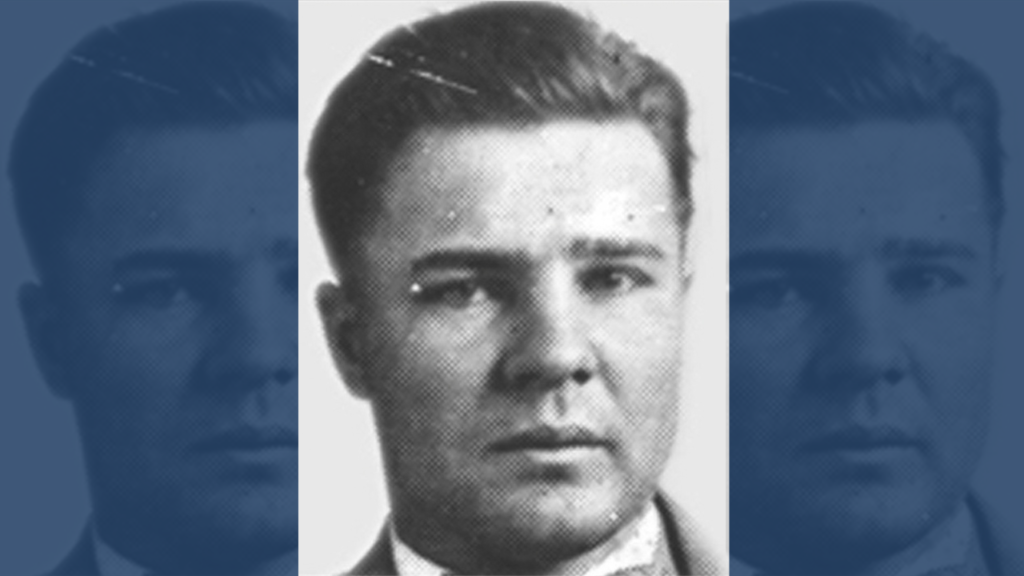
Pretty Boy Floyd’s Secret Quincy Connection: FBI Files Point to North Second Street
Federal investigative records uncovered by Quincy Current show that agents pursuing one of America’s most notorious Depression-era gangsters received information that Charles “Pretty Boy” Floyd regularly visited a woman in Quincy, leading federal investigators to a North Second Street address already known to local authorities.
QUINCY, Ill. One of the most infamous outlaws of the Depression era may have had a far more direct connection to Quincy than local history has generally remembered.
Recently reviewed federal investigative records show that agents searching for Charles Arthur “Pretty Boy” Floyd received information in early 1934 that the notorious bank robber was believed to regularly visit a woman named Marie Poe in Quincy.
The documents do not establish that Floyd was ever arrested, photographed or otherwise independently confirmed at the Quincy address. What they do show is that federal investigators considered the Quincy lead significant enough to circulate it among multiple offices and pursue additional investigation.
And the deeper Quincy Current dug into the records, the more intriguing the local connection became.
A January 1934 Bureau of Investigation letter contained in the Kansas City Massacre files states that information had been received from an informant regarding Floyd’s movements. The source told investigators that Floyd “frequently goes to Quincy, Illinois,” where he visited a woman identified as Marie Poe.
The letter listed her address as 422 N. Second St. and requested additional investigation through federal offices in St. Louis and St. Paul.
The reference appears in files associated with the federal investigation into the Kansas City Massacre and the nationwide search for Floyd and others connected to the case.
A later federal report adds even more detail, and appears to correct or clarify the address.
The Bureau report identified an associate at 522 N. Second St. in Quincy and described the property as a house of prostitution operated by Marie Poe. Investigators also obtained information about people living at the address and telephone calls associated with the residence. FBI
That 522 N. Second St. address matches the address Quincy Current found repeatedly in local newspaper archives connected to Poe.
The FBI records therefore appear to provide something that has largely disappeared from Quincy’s popular history: a documented federal investigation connecting Pretty Boy Floyd to a woman and residence in the city.
A Depression-era public enemy
Charles Arthur Floyd became one of the best-known criminals in America during a period when bank robbers including John Dillinger, Bonnie and Clyde, Baby Face Nelson and members of the Barker-Karpis gang dominated national headlines.
The FBI’s historical records describe Floyd as a highway robber and bank robber who became a nationally hunted fugitive.
Floyd had already served prison time in Missouri and was later sentenced in Ohio following a bank robbery conviction. He escaped while being transported to prison and returned to a life on the run.
By 1933, federal authorities were pursuing him in connection with the Kansas City Massacre, the June 17, 1933, gun battle outside Union Station in Kansas City, Missouri, that left four law enforcement officers and federal prisoner Frank Nash dead.
The FBI has long maintained that Floyd, Vernon Miller and Adam Richetti were involved in the attempt to free Nash. FBI
That investigation generated thousands of pages of reports, informant statements, telephone records, surveillance leads and correspondence between federal offices.
Buried within those records is Quincy. The woman federal agents were investigating
The Marie Poe mentioned in the federal records appears to have been a woman already familiar to Quincy authorities.
Quincy Current’s review of historical Quincy newspaper archives found references to Marie Besling, also known as Marie Poe, at 522 N. Second St.
In July 1935, local newspaper accounts reported that she was charged with being the keeper of what was then legally described as a “bawdy house,” an older term commonly used for a brothel or house of prostitution.
That case was later dismissed because of a lack of witnesses, according to the archived reporting.
Her name would surface again in connection with another criminal case.
Newspaper records reviewed by Quincy Current reported that Poe posted $1,000 bond for Cecil Qualls after Qualls was accused of involvement in the hijacking of a liquor shipment in Quincy.
That detail does not establish that Poe participated in the alleged hijacking or any other criminal conduct associated with Qualls. It does, however, show that she remained connected to people appearing in local law enforcement and court reports during the same general period federal investigators were tracking organized criminal activity across the Midwest.
Decades later, her name surfaced again.
In 1960, local newspaper coverage reported that Marie Poe was among those caught during a police raid involving an alleged house of prostitution.
Taken together, the local records provide considerably more context for why a Quincy address connected to Poe might have attracted the attention of investigators tracking a nationally wanted gangster.
The address discrepancy
One particularly interesting detail is the address itself.
The January 1934 federal correspondence reviewed by Quincy Current appears to identify Marie Poe at 422 N. Second St.
Local newspaper archives, however, consistently associate Poe with 522 N. Second St.
A subsequent federal report also identifies the Quincy location as 522 N. Second St., describing it as a house of prostitution operated by Marie Poe. FBI
That suggests the 422 address in the earlier correspondence may have been incorrect information supplied by an informant, a transcription error or information later clarified by investigators.
The surviving records do not definitively explain the discrepancy.
What is clear is that both the later FBI report and Quincy newspaper archives converge on 522 N. Second St.
Investigators looked at the phone records
The federal investigation did not end with simply recording Poe’s name.
Another Bureau document shows investigators were examining telephone activity connected with her.
A later FBI report directed agents to determine the identity of someone who had called Marie Poe in Quincy on Nov. 5, 1933, from a Chicago telephone number.
The document explicitly states that Poe had been “reported to be a friend of ‘Pretty Boy’ Floyd.”
Investigators contacted the Illinois Bell Telephone Co. in an attempt to identify the person behind the Chicago number. By the time agents pursued the lead, however, the telephone exchange had been reorganized and the necessary records no longer existed.
The FBI reported that it therefore could not determine who had made the call. FBI
That document is significant because it demonstrates that the Quincy connection was not merely a single passing reference in an informant’s statement.
They examined Poe’s telephone activity, attempted to identify callers and incorporated the Quincy information into the broader investigation surrounding Floyd and the criminal networks associated with him.
Did Pretty Boy Floyd actually come to Quincy?
That remains the unanswered question.
The documents do not contain a photograph of Floyd standing on North Second Street.
They do not contain an arrest report placing him in Quincy.
They do not appear to include a statement from a Quincy police officer saying he personally saw Floyd at the residence.
Instead, the records document intelligence received by federal investigators from informants and law enforcement sources during the massive effort to locate Floyd.
The files establish that federal authorities received reports that Floyd visited Quincy and that they investigated a Quincy woman reported to be his friend. They do not, by themselves, conclusively prove every visit described by informants actually occurred.
Still, there is substantially more here than a piece of local folklore.
The connection appears in official federal investigative files. A follow-up report identifies the North Second Street residence. Agents investigated telephone activity connected with Poe. Local newspaper archives independently place her at the same address and document her involvement with a residence authorities later associated with prostitution.
For a man who survived by moving between safe houses, acquaintances and underworld contacts, Quincy would also have been geographically plausible.
The city sat along major river, rail and highway routes connecting St. Louis, Chicago, Kansas City and other Midwestern population centers.
A hidden piece of Quincy history
Floyd’s story ended less than a year after investigators began looking into the Quincy connection.
On Oct. 22, 1934, federal agents and local law enforcement officers caught up with him near East Liverpool, Ohio. Floyd was shot while attempting to flee and died shortly afterward. He was 30. FBI
His death helped close one of the most notorious chapters of the Depression-era gangster period.
The Quincy chapter, however, appears to have been largely forgotten.
The house on North Second Street is not commonly mentioned alongside the traditional stories of Pretty Boy Floyd, nor does it still stand.
Marie Poe rarely appears in modern retellings of his movements.
Yet inside the surviving federal files, Quincy appears plainly enough to have sent investigators searching through names, addresses and telephone calls.
More than 90 years later, those records offer a tantalizing glimpse into a side of Quincy that would have existed largely in whispers at the time.
Somewhere along North Second Street, federal investigators believed there was a woman Pretty Boy Floyd knew.
And according to the informants they were listening to, one of America’s most wanted gangsters knew the way to Quincy.