
Months Before She Vanished, Amelia Earhart Visited Quincy
Purdue Researchers Are Searching for the Plane She Told Quincyans She Hoped to Fly Around the World
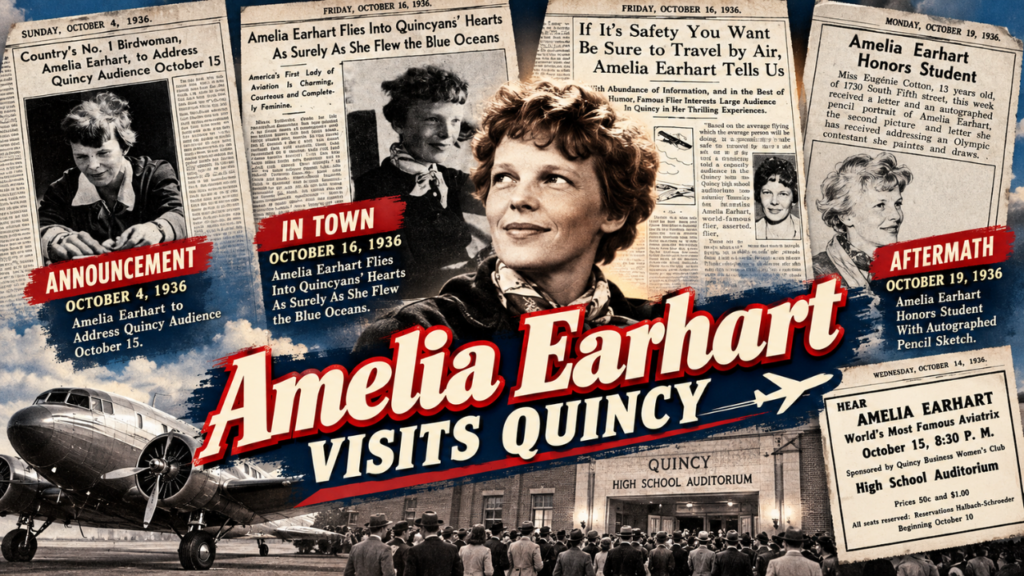
On October 15, 1936, Amelia Earhart spent several hours in Quincy, stayed at the Hotel Lincoln-Douglas and filled the Senior High School auditorium with stories of aviation and the future. During a newspaper interview that afternoon, she acknowledged reports that she planned to fly around the world and revealed that her new airplane was already equipped for such a journey. Less than nine months later, she disappeared over the Pacific. Today, a Purdue-backed expedition is searching a remote South Pacific lagoon for what researchers believe could be that very airplane.
Nearly 90 years ago, Amelia Earhart arrived in Quincy carrying one of the most famous names in the world.
She was already an international celebrity: the first woman to fly solo across the Atlantic, a record-setting pilot, author, lecturer and advocate for women entering professions that had long been dominated by men.
But on Thursday, October 15, 1936, Quincy residents were able to see the person behind the headlines.
She came to town for a lecture sponsored by the Quincy Business Women’s Club, spoke before a large audience at Senior High School and spent part of the afternoon talking with local reporters from her room at the Hotel Lincoln-Douglas.
What she told those reporters is now especially striking.
Earhart acknowledged that newspapers were saying she intended to fly around the world.
She said the plans were not yet definite.
But then she added something that, with the benefit of history, reads almost like a preview of the mystery that would soon consume the world:
Her new airplane was equipped for round-the-world flying.
That airplane was the Lockheed Electra 10-E that disappeared with Earhart and navigator Fred Noonan in July 1937.
And as Quincy looks back on Earhart’s visit today, researchers backed by Purdue University — the same university closely connected to Earhart and her Electra — are at this very moment searching a remote Pacific island lagoon for what may be the remains of that aircraft.
Quincy prepared for a celebrity
Earhart’s appearance was being promoted well before she reached town.
The October 4 edition of the Quincy Herald-Whig reported that the Quincy Business Women’s Club was selling tickets for Earhart’s October 15 lecture in the High School auditorium. Club members were speaking before service clubs and other organizations to generate interest, and the newspaper called the engagement one of the most important undertakings the organization had attempted.
Earhart was not merely another speaker passing through Quincy.
She was one of the most recognizable women in America.
And local interest reflected it.
She arrived by car
For all of Earhart’s association with flight, she did not arrive in Quincy by airplane.
The Herald-Whig reported that she motored into Quincy in her Cord automobile shortly after noon on October 15 after speaking the previous evening in LaSalle, Illinois.
She checked into the Hotel Lincoln-Douglas, one of Quincy’s most prominent hotels.
Local reporters soon joined her there.
The resulting article appeared beneath the memorable headline:
“Amelia Earhart Flies Into Quincyans’ Hearts As Surely As She Flew the Blue Oceans.”
The newspaper portrayed a woman much less imposing than the aviation legend readers knew from national headlines.
Earhart was described as slim and graceful, with a tanned face and striking blue eyes. She wore a brown plaid skirt, dark sweater and an orange-and-white scarf.
The reporters’ verdict after leaving her suite was considerably less formal:
She was charming, approachable and easy to talk with.
A conversation that now seems prophetic
The most important part of that interview came when Earhart was asked what she intended to do next.
She laughed.
Newspapers, she explained, were saying she planned to go around the world.
She had not yet settled every detail.
But her aircraft, she acknowledged, had been equipped for round-the-world flying.
That detail deserves particular attention now.
Earhart’s airplane was a specially modified Lockheed Electra 10-E, financed in significant part through the Purdue Research Foundation’s Amelia Earhart Fund for Aeronautical Research. Purdue regarded the aircraft as a “Flying Laboratory,” and Earhart intended it to return to the university following her circumnavigation. Purdue University
In other words, when Earhart sat in a Quincy hotel room discussing the possibility of flying around the world, she was talking about the same aircraft that an expedition associated with Purdue is now trying to locate nearly nine decades later.
Earhart and Purdue
Earhart’s connection to Purdue had become an important part of her life by the time she came to Quincy.
She served the university as a consultant, particularly encouraging women to consider careers beyond conventional expectations, while also working with Purdue’s aviation program.
The Quincy newspaper described her dual role and her interest in what she called the changing place of women in American society.
It is difficult to overlook the symbolism of that message in a room filled with young women in 1936.
Earhart was not only describing airplanes.
She represented possibility.
And at least two Quincy girls who encountered her would later prove just how powerful that example could be.
Dinner in Quincy, then the main event
Following her afternoon at the hotel, Earhart had a dinner engagement at the home of Mrs. L.P. Bonfey.
Then she went to Senior High School (Present day Junior High).
The Herald-Whig said she spoke before a large audience and combined information about aviation with humor and first-person accounts of her extraordinary flights.
For more than an hour, Earhart talked about the evolving world of aviation.
Her style apparently mattered as much as her subject.
The newspaper described her presentation as conversational and intimate rather than formal, and said her humor quickly won over the audience.
Convincing Quincy that flying was safe
Earhart had spent years doing something that may seem strange today.
She was trying to convince ordinary Americans that airplanes were not merely machines for adventurers and daredevils.
At Senior High School, she turned the auditorium into something resembling an informal survey.
She asked how many people had ridden in an airplane during the previous three years.
Then she posed another question: if she could offer them a trip the following day on a scheduled airline to somewhere they wanted to go — with a return flight — how many would accept?
Finally she asked how many still would refuse.
Her point was straightforward.
Commercial aviation was becoming practical transportation.
Airplanes were no longer simply curiosities of the barnstorming age.
Earhart argued that air travel could be safe, economical and comfortable — and that it represented the future.
The risks she knew better than anyone
Earhart nevertheless understood that her own flying was hardly routine.
She told the Quincy audience about the hazards surrounding her ocean flights, including the psychological strain that could come before takeoff.
Weather forecasts, wind direction and the anxiety of those around her could become hazards of their own.
She also entertained the audience by describing the emergency equipment she had been persuaded to carry.
Among the items were an inflatable rubber boat roughly the size of a hotel bathtub, small oars, a flotation vest, signal equipment and flares.
Her airborne provisions could include malted-milk tablets, chocolate, tomato juice and water.
The newspaper found her treatment of such dangers remarkably humorous.
Wiley Post’s advice
Earhart also recalled advice she had received from another legendary aviator.
Wiley Post, who had circled the globe and died alongside Will Rogers in an Alaska plane crash in 1935, had once offered her one simple instruction:
“Relax.”
The Herald-Whig used that observation while describing Earhart during its hotel-room interview.
A photograph accompanying the article captured a calm, smiling Earhart shortly before she left the hotel to speak before the Senior High audience.
In hindsight, the moment feels almost suspended in time.
Earhart was still months away from disappearing.
Her world flight was still something she could discuss casually.
The mystery did not yet exist.
One Quincy girl interviewed her
Among the students drawn into Earhart’s visit was Margaret Catherine “Marge” McIntire, then a Quincy High School student. McIntire was given an extraordinary opportunity: she interviewed Amelia Earhart for the school newspaper.
That student publication was The Q Review. McIntire graduated in 1937, and decades later her obituary specifically remembered the Earhart interview as helping deepen her interest in newspaper work.
McIntire later worked in advertising and eventually enlisted in the United States Marine Corps during World War II.
Her military assignment was remarkably fitting. She became a combat correspondent.
The Quincy teenager who had once questioned Amelia Earhart became a professional journalist in uniform.
It would be impossible to argue that a single meeting determined McIntire’s entire life.
But her family biography remembered the Earhart interview decades later precisely because it mattered.
Another Quincy girl chose the sky
Another teenager exposed to Earhart’s visit would follow an even more direct path.
Patricia Bonansinga, born in Quincy in 1921, was already fascinated by aviation. As a child she had ridden in a Ford Tri-Motor.
Then, while still in high school, she heard Amelia Earhart speak.
Later biographical accounts specifically remembered Earhart’s appearance as making a lasting impression on Bonansinga. The recollection gives the year as 1937, but the contemporary Quincy newspapers now establish the documented Senior High appearance as October 15, 1936.
Bonansinga was about 15 years old. A few years later, America entered World War II. And Patricia Bonansinga became a pilot.
She joined the Women Airforce Service Pilots — the WASP — the pioneering group of women who flew military aircraft within the United States to free male pilots for combat assignments.
Bonansinga ferried aircraft, towed aerial gunnery targets, tested airplanes and participated in flight-instruction work.
The teenage girl who had listened as Amelia Earhart told a Quincy auditorium about the future of aviation eventually became part of that future herself.
And then there was the drawing
Earhart’s visit left behind another remarkable Quincy story. Local schoolchildren created posters and artwork welcoming the famous aviator.
One stood out. 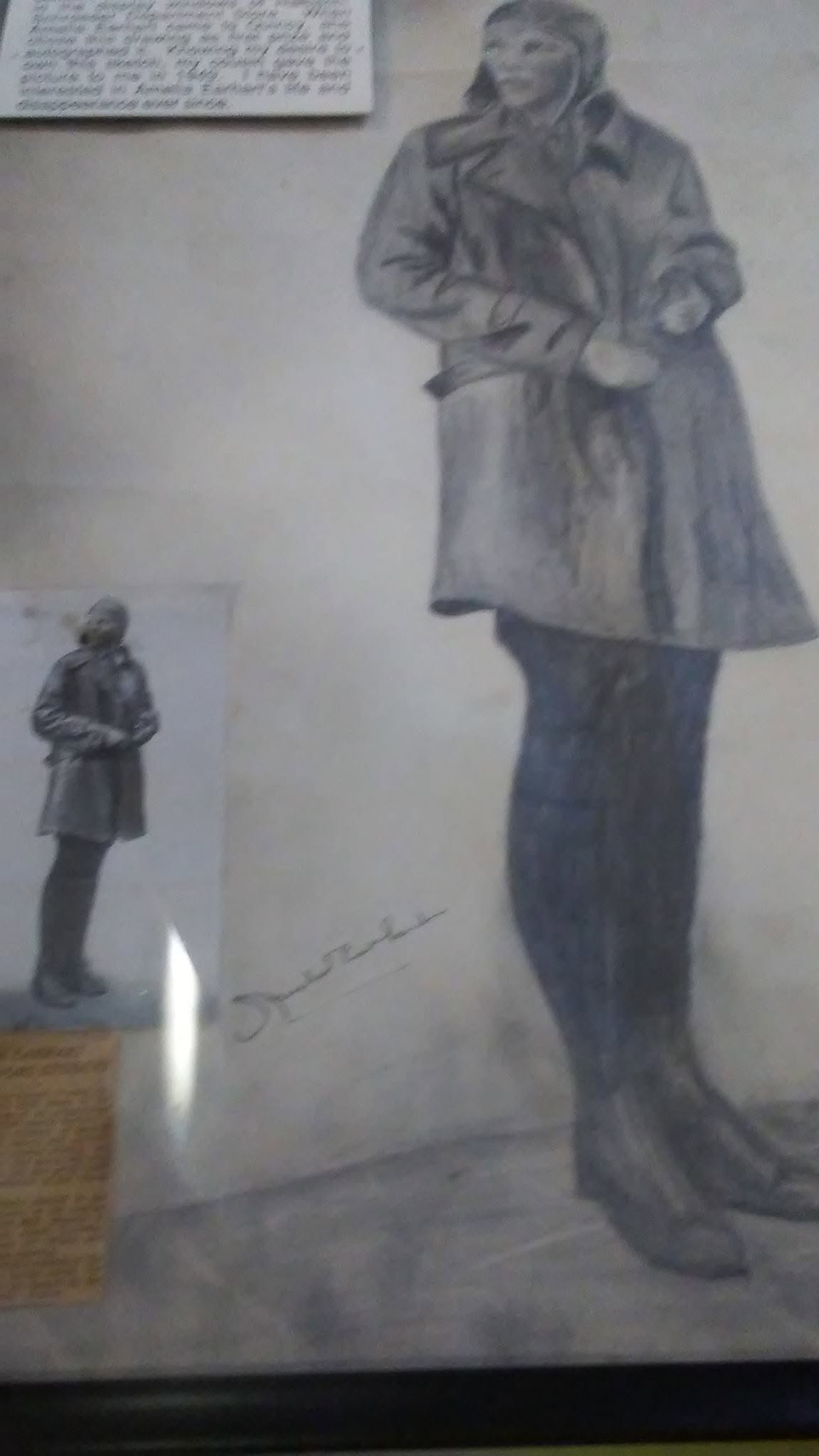
Eugenie Cotton, a 13-year-old eighth-grade student at Irving School who lived at 1725 South Fifth Street, created a full-size pencil portrait of Earhart in her flying uniform.
Earhart saw it.
She was impressed enough to arrange a meeting with Eugenie at Senior High School immediately before the lecture.
There, Earhart signed the drawing.
The October 19 Herald-Whig reported the encounter under the headline:
“Amelia Earhart Honors Student.”
The newspaper said Cotton was the proud owner of the autographed portrait and that the drawing had been placed on display in the window of Halbach-Schroeder.
The drawing apparently had a much longer life than anyone standing in Senior High School that evening could have imagined.
A pencil sketch associated with Earhart’s visit later surfaced in the auction world many decades afterward, adding one more tangible thread between the famous aviator and the children who welcomed her to Quincy.
Several years ago, that original sketch was for sale at a local auction, and fetched $1,700.
She left Quincy the following morning
Earhart’s stay was short.
The newspaper reported that she planned to leave Friday morning for Ottumwa, Iowa, followed by another speaking engagement in Columbia, Missouri.
Her lecture tour would continue until approximately mid-November before she returned to Purdue.
Ironically, she admitted to reporters that she would have preferred to fly between lecture stops.
Airline schedules made that impractical.
So America’s most famous aviator drove away from Quincy.
Less than nine months later
The plans Earhart had discussed in her Hotel Lincoln-Douglas room soon became reality.
On June 1, 1937, Earhart and navigator Fred Noonan departed Miami attempting to circumnavigate the globe near the equator. By early July they had traveled approximately 22,000 miles.
On July 2 they took off from Lae, New Guinea, bound for tiny Howland Island in the central Pacific.
They never arrived.
Radio transmissions indicated Earhart was searching for Howland while fuel was becoming dangerously scarce.
Then the transmissions stopped.
Neither Earhart, Noonan nor their Lockheed Electra was conclusively found.
For almost 90 years, the disappearance has generated searches, theories, books and expeditions.
Now one of the most ambitious efforts in years is unfolding.
Purdue returns to the mystery
In October 2026, a 17-member expedition involving the Archaeological Legacy Institute, Purdue Research Foundation and Purdue University traveled to Nikumaroro, an uninhabited atoll in the Republic of Kiribati roughly 400 miles south of Earhart’s intended destination at Howland Island. Purdue University
The team is investigating what researchers call the Taraia Object.
The anomaly was first recognized in satellite imagery in 2020, but researchers subsequently determined that something resembling the object can also be seen in aerial photographs of the lagoon dating to 1938 — less than a year after Earhart disappeared.
The hypothesis is that Earhart and Noonan, unable to locate Howland Island, may have followed a navigational line southeast and reached Nikumaroro, where they could have landed on the reef before the aircraft was eventually carried into the lagoon.
It remains a hypothesis.
And there is considerable skepticism.
Veteran Earhart researcher Ric Gillespie, himself a longtime advocate of the Nikumaroro castaway theory, has suggested the particular object being investigated may simply be a fallen tree. Reuters
But Purdue and the expedition team are testing the question directly.
The search is happening now
On October 12, 2026, after a five-day, roughly 830-nautical-mile voyage, the expedition arrived at Nikumaroro. Purdue University
And on October 14 — almost exactly 90 years after Quincy was preparing to welcome Earhart — underwater fieldwork began.
Researchers entered the lagoon and started surveying the Taraia Object site using magnetometers and side-scan sonarbefore planned excavation using a hydraulic dredge. Purdue University
The historical connection to Purdue is not incidental.
The Purdue Research Foundation helped finance Earhart’s Electra through the Amelia Earhart Fund for Aeronautical Research.
Earhart intended that the airplane return to Purdue after she completed the world flight.
It never did.
Now Purdue is helping search for it.