
A Prayer Book, a Rosary and a Quincy Soldier: The Remarkable Wartime Story of James L. Veile
A 1945 Quincy newspaper account tells the extraordinary story of a 20-year-old local soldier whose small Catholic prayer book and rosary were credited with stopping shrapnel that might otherwise have struck him in the heart.
QUINCY, Ill. In the middle of one of the most violent chapters of World War II, a young Quincy soldier carried something simple over his heart. Inside the left breast pocket of his uniform were a small Catholic prayer book and a rosary. They were not armor. They were not military equipment. They were objects of faith, carried close to the body by a 20-year-old far from home. Then came Dec. 15, 1943.
Tech. Sgt. James L. Veile of Quincy was fighting near San Pietro, close to Cassino, Italy, when he was struck directly by fragments from a hand grenade during fierce combat. The blast left him with 15 serious wounds, primarily along the right side of his body, including injuries to his ear, arm and leg.
But according to a remarkable account published by The Quincy Herald-Whig on Jan. 7, 1945, the fragments that might have struck Veile in the chest instead tore into the small prayer book and rosary he carried in his pocket over his heart. The newspaper did not hesitate to describe what happened in extraordinary terms. “At least one of his escapes can be attributed to a miracle,” the article reported.
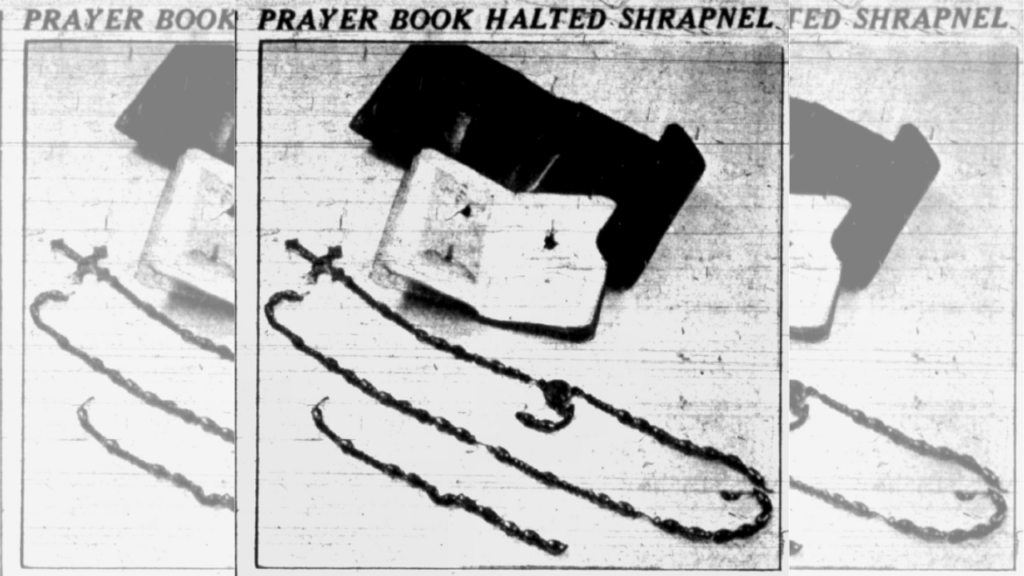
The photograph accompanying the story showed the physical evidence. 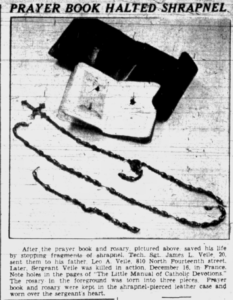
The little volume, identified as “The Little Manual of Catholic Devotions,” was punctured by shrapnel. The rosary had been torn into three pieces. Both had been carried inside a leather case, which was also pierced.
Had those objects not been there, the newspaper reported, the sharp fragments likely would have continued into Veile’s body and could have caused his death.
For the Veile family in Quincy, the battered prayer book and broken rosary became much more than damaged possessions.
They became reminders of a moment when their son survived.
Veile was only 20 when the Herald-Whig told his story.
His father, Leo A. Veile, lived at 810 N. 14th St. and worked as a clerk in the mailing division of the Quincy post office.
James had already endured more than one close call in combat.
After being wounded near San Pietro, he was flown to a hospital in North Africa. He later returned to Naples, Italy, in early March and was soon back in action. By June, he had reached Rome as Allied forces advanced through Italy.
At some point after surviving the grenade blast, James sent the damaged prayer book and rosary home to his father in Quincy.
He also sent home his Purple Heart, other military awards and souvenirs he had collected during the war, including German items from battlefields where he had served.
One can imagine what those objects must have meant when they arrived at the Veile home. A father could hold the small book in his hands and see the holes punched through its pages.
He could look at the broken rosary. He could see, in tangible form, just how close his son had come to dying thousands of miles from Quincy.
And for a time, James had survived. The surviving newspaper photograph makes the story particularly powerful.
The prayer book is visibly damaged. The rosary lies beside it in pieces. The leather case that once held them bears the evidence of the blast. They are humble objects, but in that moment they had become something else entirely. The newspaper’s account said the book and rosary were in Veile’s left shirt pocket directly over his heart.
When the shrapnel came, that was where it struck.
The Herald-Whig’s headline was simple and unforgettable:
“Prayer Book Halted Shrapnel.”
The story, however, did not end with Veile’s survival in Italy.
A year and one day after the grenade blast that he survived, his family received devastating news.
Veile was killed in action Dec. 16, 1944, in southern France. The War Department notification reached his father in Quincy in early January 1945.
Leo Veile received the message while working at the Quincy post office. The same father who had previously received the pierced prayer book, broken rosary and Purple Heart from his son now received official word that James would not be coming home.
That contrast gives the old newspaper clipping an emotional weight that remains more than 80 years later. The prayer book had not protected James from every danger of war.
But for one day in Italy, according to the account preserved in the Herald-Whig, it appears to have stood between him and death.
That gave him another year of life.
Another year to serve.
Another year to write home, send keepsakes to Quincy and remain connected to the family waiting for him.
Whether viewed as providence, remarkable circumstance or the miracle the newspaper described it as, the physical evidence offered one grieving Quincy family something extraordinary to hold onto. For one terrible moment on a battlefield in Italy, a little prayer book and rosary stood in the path of war.
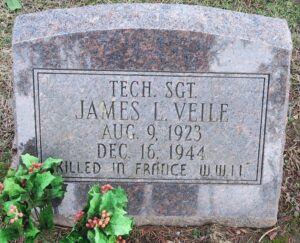 His grave at Calvary Cemetery now serves as a quiet reminder of a life that was brief but filled with extraordinary service. Visitors who know his story may see more than a military marker. They may think of the little prayer book pierced by shrapnel, the rosary torn apart by the force of a grenade and a 20-year-old soldier who survived that day against extraordinary odds.