
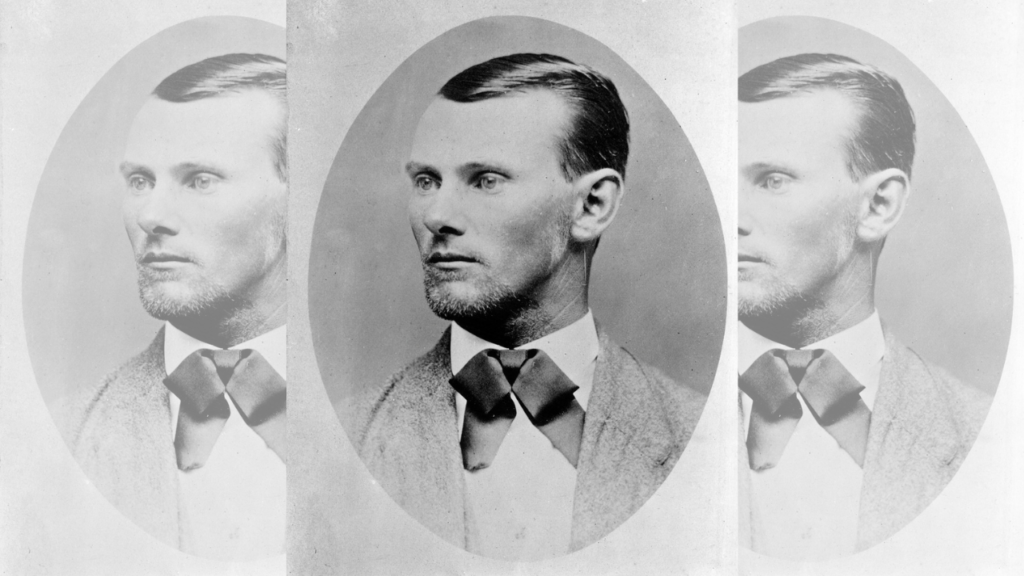
“They Often Came to Quincy”: Historic Interview Links Jesse and Frank James to Quincy
Did Jesse James Visit Quincy? Library of Congress Interview Claims the Notorious Outlaw Was a Familiar Sight
A 1938 Federal Writers’ Project interview uncovered by Quincy Current contains an extraordinary claim from a Quincy-born man who said he encountered Jesse and Frank James in the city and saw the famous outlaws there on multiple occasions.
QUINCY, Ill. More than a century after Jesse James became one of the most recognizable outlaws in American history, a largely forgotten interview preserved by the Library of Congress raises an intriguing possibility about Quincy’s past. Jesse James may have been here, and according to one man who grew up in Quincy, he was not here just once.
While researching the Library of Congress’ American Life Histories collection, Quincy Current located a 1938 Federal Writers’ Project interview with L.A. Sherman, a Quincy native who recalled encountering Jesse James and his brother Frank at an eating establishment in the city. Sherman did not describe the encounter as rumor or something passed down through his family. He said he was there.
The seven-page manuscript includes a section titled “Meeting Up With Jesse James,” in which Sherman recalled sitting in what he called an “eatin’ house” in Quincy when he realized one of the men in the room was Jesse James.
“I found out that one of the men sittin’ there was Jesse James,” Sherman told the interviewer. Sherman then made an even broader claim about the James brothers. “They often came to Quincy,” he recalled.
Later in the same passage, Sherman said he had “seen them lots of times.” If accurate, Sherman’s recollection would give Quincy an unexpected connection to one of the most notorious criminal figures of the 19th century.
The interview was conducted in October 1938 at Sherman’s home in Hastings, Nebraska.
Federal Writers’ Project paperwork identifies him as L.A. Sherman and records the interview as taking place over three visits totaling approximately six hours.
The accompanying personal history is particularly important because it establishes Sherman’s connection to Quincy.
The document records his birthplace as Quincy on Jan. 9, 1861, and indicates that he lived in Quincy during his childhood before spending time in Wisconsin and later Missouri. He eventually settled in Hastings.
That timeline would have made Sherman a child during the years immediately following the Civil War, precisely the period he associated with his memories of the James brothers.
Sherman told the interviewer the encounters occurred during the years after the Civil War and into the 1870s. That places his recollection during the period when Jesse and Frank James were developing their reputations as Missouri outlaws and when their movements frequently took them across the Midwest.
Sherman’s description is unusually vivid.
He remembered Jesse James carrying two large revolvers on his hips. Frank James, Sherman said, was there as well. He described both men as well dressed and remembered their facial hair, clothing and horses. According to Sherman, the brothers arrived on horseback and were particular about their animals. He estimated that their horses weighed about 1,100 pounds and described them as being built for speed.
The saddles apparently made an impression on him, too.
“They had the prettiest saddles. Silver all over,” Sherman recalled.
Those are the kinds of seemingly incidental details that make the Federal Writers’ Project interviews so valuable to historians. The documents were not formal law enforcement statements. They were attempts to record how ordinary Americans remembered the people, places and experiences of an earlier generation.
Perhaps the most remarkable sentence in the entire interview comes near the bottom of the page.
“Quincy was a great town for them to hang out,” Sherman told the interviewer. Sherman was asserting that Quincy was a place the James brothers knew and visited with some regularity.
He also mentioned the Ford brothers, who later became associated with the final chapter of Jesse James’ life, and spoke broadly about the group of men as people he remembered seeing during those years.
Sherman’s recollections portray the outlaws much differently from the image created by later movies and popular culture.
He remembered them as armed men who could be intimidating, but he also repeated the period’s familiar Robin Hood-style portrayal of the James brothers as men who were sympathetic to poor people.
Sherman claimed the men sometimes gave money to people who told them they were struggling financially. “The James boys were liked by the poor,” Sherman recalled.
Sherman was interviewed in 1938, approximately six decades after the events he was describing.
His testimony was recorded as an oral history, not as a sworn statement contemporaneous with the alleged encounters.
There are also details elsewhere in Sherman’s account that demonstrate the limitations of relying entirely on decades-old memory.
For example, Sherman’s version of Jesse James’ eventual death differs from the generally accepted historical account. That discrepancy is an important reminder that oral histories can preserve valuable firsthand memories while also containing mistakes, embellishments or details altered over many years of retelling.
The document therefore does not prove by itself that Jesse James visited Quincy.
It does something different.
It establishes that a Quincy-born man interviewed by a federal historical project in 1938 specifically claimed that Jesse and Frank James visited Quincy, that he personally encountered them and that he remembered seeing them repeatedly. That is considerably stronger historical evidence than a modern legend appearing without a source.
The Federal Writers’ Project preserved memories before they disappeared
Sherman’s interview survives because of an enormous Depression-era effort to preserve the experiences of ordinary Americans.
The Federal Writers’ Project was established during the New Deal as part of the Works Progress Administration. In addition to providing employment for writers, journalists, teachers, librarians and other workers, the program dispatched interviewers across the country to document American life.
The resulting collection includes thousands of firsthand narratives about immigration, occupations, regional customs, the Civil War, frontier life and encounters with famous historical figures.
Sherman was exactly the kind of person the program hoped to document.
By 1938, he was an elderly man remembering a childhood that reached back to the Civil War era.
The interviewer recorded not only his Jesse James story but also his memories of Quincy during the Civil War and other episodes from his childhood.
In another portion of the manuscript, Sherman described his family living in Quincy during the war and recalled his father carrying a musket because of threats from bushwhackers in the Mississippi River bottoms.
Those recollections place his Jesse James story within a much larger narrative of growing up in and around Quincy during a turbulent period of American history.
Could Quincy have been a convenient stop? Geographically, the claim is at least plausible.
Quincy was an important Mississippi River community with steamboat traffic, rail connections, hotels, restaurants, saloons and considerable movement between Illinois and Missouri.
For men trying to travel without attracting attention, communities along major transportation corridors offered opportunities to obtain food, horses, lodging and information before moving on.
Sherman’s account does not identify the eating house where he said the encounter occurred. It does not provide a street address. It also does not identify a particular robbery that brought the James brothers to Quincy.
Those unanswered questions leave considerable room for additional research.
Newspaper archives, hotel registers, court records, railroad documents, police reports, diaries and other 19th-century sources could potentially provide corroborating evidence or reveal whether the James name appeared elsewhere in Quincy during the period Sherman remembered.
For now, the importance of the discovery lies in the source itself.
It comes from a man born in Quincy in 1861 whose memories were recorded by a federal interviewer in 1938 and ultimately preserved in the Manuscript Division of the Library of Congress.
Nearly 90 years after Sherman sat down to tell his stories, his words provide a tantalizing new lead for Quincy historians. He remembered sitting down for a meal and discovering Jesse James nearby. He remembered Frank James. He remembered the horses, the guns, the elaborate saddles and the way the men dressed.
Most importantly, he remembered seeing them more than once.
Whether additional records will ever conclusively establish that Jesse James spent time in Quincy remains an open question.
But buried inside a Library of Congress manuscript is the testimony of one old Quincy native who had no doubt.
In his memory, the James brothers came to Quincy often.